Introduction
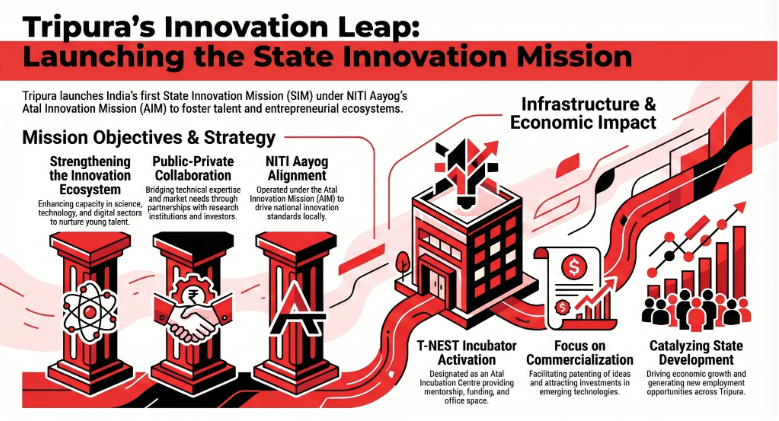
On March 3, 2026, the Government of Tripura formally launched the State Innovation Mission (SIM), marking the first initiative of its kind at the state level in India. Operating under the framework of the Atal Innovation Mission (AIM) by NITI Aayog, the SIM is designed to transform Tripura into a regional hub for technological advancement and entrepreneurship. The mission focuses on nurturing youth talent, providing incubation support, and bridging the gap between technical research and market commercialization. By leveraging public-private partnerships and dedicated infrastructure like the T-NEST incubator, the mission aims to catalyze economic development and generate significant employment opportunities within the state.
Mission Overview and Strategic Alignment
The State Innovation Mission (SIM) represents a localized extension of India's national innovation strategy. Its primary function is to create a robust ecosystem that supports the progression from ideation to industrial application.
National Integration: The mission is established under the umbrella of the Atal Innovation Mission (AIM), a flagship initiative of NITI Aayog.
Visionary Goal: The overarching objective is to transform Tripura into a vibrant innovation hub by establishing necessary infrastructure and fostering cross-sector collaboration.
Stakeholder Synergy: The mission promotes active cooperation among:
Individual innovators
Academic institutions
Start-ups
Industry leaders
Core Objectives and Strategic Focus
The SIM is structured to address multiple facets of the innovation lifecycle, from talent identification to the protection of intellectual property.
Key Pillars of the Mission
Capacity Building: Enhancing the state's internal capacity for innovation and supporting new entrepreneurial ventures.
Youth Empowerment: Nurturing the talents of young people specifically in the fields of science, technology, and digital innovation.
Commercialization: Facilitating the patenting of original ideas and their subsequent transition into the commercial market.
Investment Attraction: Creating an environment that draws capital toward emerging technologies and early-stage ventures.
Institutional Infrastructure: T-NEST
A critical component of the SIM is the formal designation of existing technical infrastructure to provide specialized support for entrepreneurs.
Feature | Description |
Designated Entity | Tripura Natural Environment & Sustainable Technologies (T-NEST) |
New Status | AIM Atal Incubation Centre (AIC) |
Mentorship | Access to professional guidance and technical expertise. |
Funding Support | Provision of financial resources for start-ups and early-stage ventures. |
Physical Infrastructure | Dedicated office space and facilities for burgeoning businesses. |
Implementation and Economic Impact
The mission adopts a partnership-heavy model to ensure that technological development remains aligned with real-world economic demands.
Public-Private Partnerships (PPP): The SIM intends to leverage the resources of private sector firms, research institutions, and investors. This strategy is intended to bridge the "technical-market gap," ensuring that expertise leads directly to viable products.
Economic Development: By fostering a start-up culture, the mission is expected to be a primary driver for economic growth in the region.
Employment Generation: The expansion of the innovation sector is projected to create new job opportunities for the local workforce.
National Contribution: The successful implementation of the SIM is intended to strengthen Tripura's overall standing and contribution to the broader Indian innovation landscape.