
Introduction
In January 2026, researchers in India announced a significant technological advancement in energy storage: the development of a high-voltage supercapacitor. Engineered by the International Advanced Research Centre for Powder Metallurgy and New Materials (ARCI), the device utilizes a novel dual-functional porous graphene carbon nanocomposite electrode. This innovation successfully overcomes the traditional voltage limitations of commercial supercapacitors, achieving an operating threshold of 3.4 volts. With enhanced energy storage capacity, high power density, and superior durability, this technology is positioned to impact sectors including electric vehicles, renewable energy integration, and grid-scale storage. Furthermore, the manufacturing process prioritizes environmental sustainability by utilizing hydrothermal carbonization to avoid harsh chemical precursors.
Overview of the Innovation
The breakthrough centers on the development of a high-performance energy storage device that addresses the safety and stability constraints inherent in existing supercapacitor technology.
Research Leadership: The innovation was developed at the International Advanced Research Centre for Powder Metallurgy and New Materials, an autonomous institute operating under India's Department of Science and Technology.
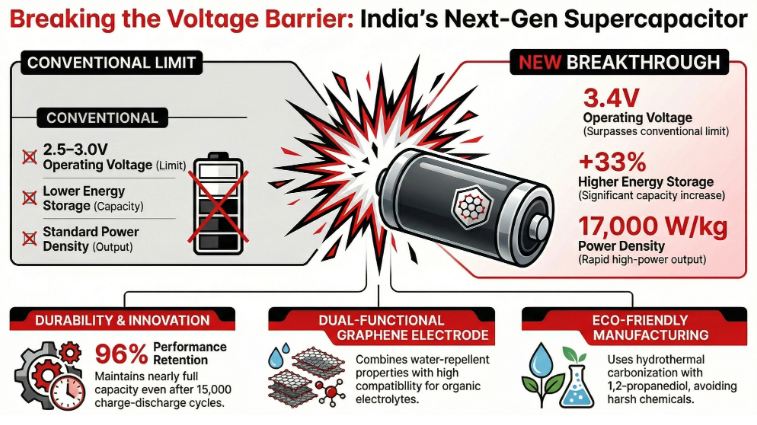
Technological Shift: While conventional commercial supercapacitors are generally restricted to an operating range of 2.5–3.0 volts due to electrolyte stability issues, this new system safely extends that range to 3.4 volts.
Electrode Composition: The core of the device is a dual-functional porous graphene carbon nanocomposite. This material is specifically designed to be water-repellent while maintaining high compatibility with organic electrolytes.
Technical Performance and Operational Efficiency
The high-voltage supercapacitor demonstrates significant improvements over existing storage solutions across several key performance metrics:
Metric | Performance Data |
Operating Voltage | 3.4 Volts |
Energy Storage Capacity | ~33% higher than conventional designs |
Power Density | Up to 17,000 W/kg |
Cycle Life | 15,000 charge–discharge cycles |
Performance Retention | ~96% after 15,000 cycles |
Mechanisms of Enhancement
The device achieves these metrics through optimized internal dynamics:
Ion Mobility: The porous structure of the graphene carbon nanocomposite facilitates rapid electrolyte penetration.
Electrochemical Efficiency: Improved ion transport reduces internal degradation during operation, contributing to the device's high durability and performance retention.
Eco-Friendly Manufacturing Process
The production of the electrode material emphasizes environmental responsibility, diverging from traditional methods that often rely on toxic substances.
Hydrothermal Carbonization: The material is synthesized via a hydrothermal carbonization process.
Chemical Precursors: The process utilizes 1,2-propanediol, effectively avoiding the use of harsh or hazardous chemicals.
Environmental Impact: This manufacturing approach reduces the overall ecological footprint of producing high-performance storage components.
Strategic Applications and Impact
The enhanced energy and power profiles of the 3.4V supercapacitor make it a viable candidate for critical infrastructure and transportation needs:
Electric Vehicles (EVs): The high power density (17,000 W/kg) and increased energy capacity address the specific demands of rapid acceleration and energy recovery in EVs.
Renewable Energy: The device can serve as a buffer for the intermittent nature of renewable sources, providing stable output.
Grid-Scale Storage: Its durability (96% retention over 15,000 cycles) makes it suitable for the long-term reliability required for utility-grade energy storage and grid management.