
Introduction
In February 2026, scientists from the Zoological Survey of India (ZSI) announced the discovery of Lepidocampa sikkimensis, a new species of Diplura found in Ravangla, Sikkim. This discovery marks a significant milestone in Indian entomology, as it is the first time a species within this primitive hexapod group has been described by an Indian research team. Beyond the identification of a new species, the study achieved a global first by providing DNA barcode data for an Indian Lepidocampa species and successfully relocating a rare subspecies, Lepidocampa juradii bengalensis, which had been missing from records for nearly 50 years.
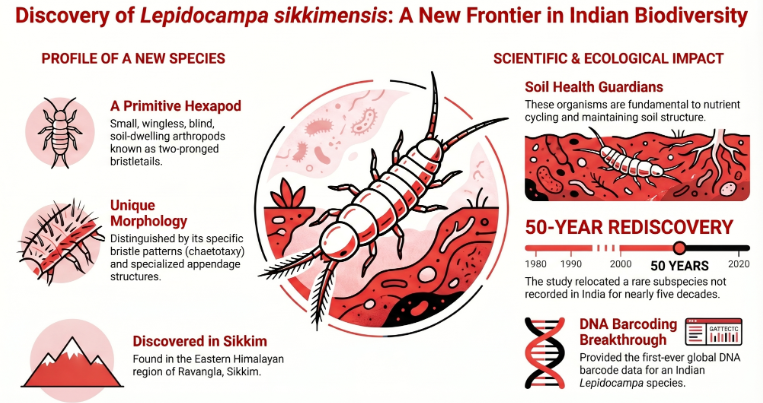
Overview of Diplura
Diplura, commonly known as two-pronged bristletails, are a group of primitive hexapods. They are characterized by the following traits:
Physical Form: Small, wingless, and blind.
Habitat: Primarily soil-dwelling arthropods.
Ecological Significance: These organisms are fundamental to soil health. They play a critical role in nutrient cycling and the maintenance of soil structure.
The Discovery of Lepidocampa sikkimensis
The identification of L. sikkimensis in the Eastern Himalayas represents a transition in the study of Indian soil fauna. While 17 species of Diplura had been documented in India previously, all were historically described by foreign researchers.
Morphological Distinctiveness
Lepidocampa sikkimensis is distinguished from other members of its genus through specific physical characteristics:
Body Scales: A unique arrangement of scales across the body.
Chaetotaxy: Distinctive bristle patterns used for identification.
Appendages: Specialized structures in its appendages that differentiate it from known relatives.
Scientific and Molecular Breakthroughs
The research conducted by the ZSI team utilized both traditional morphology and modern molecular techniques, leading to two major secondary findings:
1. Global Molecular Milestone
The study provided the first-ever DNA barcode data globally for an Indian Lepidocampa species. This data serves as a vital bridge between traditional morphological descriptions and modern molecular phylogenetics, allowing for more accurate classification and evolutionary tracking.
2. Rediscovery of Rare Subspecies
During the study, researchers successfully relocated Lepidocampa juradii bengalensis. This rare Indian Diplura subspecies had not been recorded or observed in nearly 50 years, making its relocation a significant update to the records of Indian soil fauna.
Summary of Key Findings
Category | Details |
Species Name | Lepidocampa sikkimensis |
Discovery Location | Ravangla, Sikkim (Eastern Himalayas) |
Research Organization | Zoological Survey of India (ZSI) |
Scientific Significance | First Dipluran species described by an Indian team |
Ecological Role | Nutrient cycling and soil structure maintenance |
Molecular Achievement | First DNA barcode for an Indian Lepidocampa species |
Associated Discovery | Rediscovery of Lepidocampa juradii bengalensis (absent for ~50 years) |
Conclusion
The discovery of Lepidocampa sikkimensis underscores the biological richness of the Eastern Himalayas and the advancing capabilities of Indian taxonomists. By combining morphological analysis with DNA barcoding, the Zoological Survey of India has updated the national records of soil fauna and contributed essential data to the global understanding of primitive hexapods.