
On February 20, 2026, the Central Government announced the release of over Rs 137 crore in grants aimed at strengthening rural local bodies in four states: Goa, Meghalaya, Sikkim, and Uttarakhand. These funds, allocated under the 15th Finance Commission, comprise "untied grants" intended to support local governance and infrastructure. The disbursements address various fiscal years, including current allocations for FY 2025-26 and previously withheld or pending installments from as far back as FY 2021-22. These grants are specifically designed to empower Panchayati Raj Institutions (PRIs) to address location-specific needs while adhering to strict utilization guidelines regarding administrative costs and essential services.
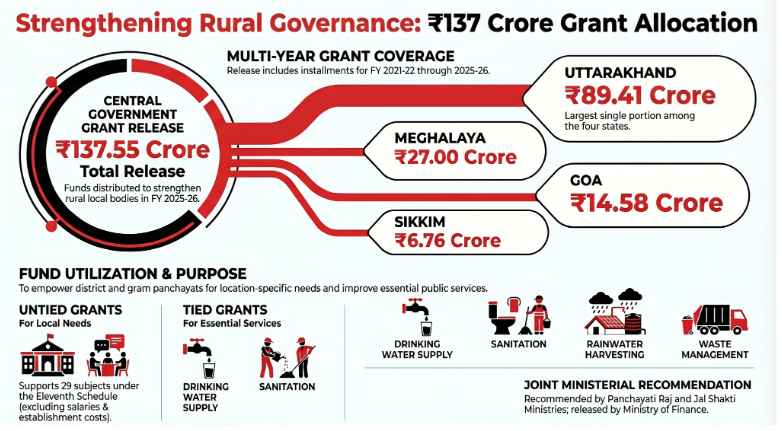
Overview of Financial Allocations by State
The total disbursement of Rs 137.75 crore is distributed across four states, targeting specific tiers of local governance including District Panchayats, Gram Panchayats, and Autonomous District Councils.
State-Wise Disbursement Breakdown
State | Amount Released (Rs Crore) | Period Covered | Beneficiaries/Scope |
Uttarakhand | 89.41 | FY 2025-26 | First installment of untied grants. |
Meghalaya | 27.00 | FY 2021-22 | Second installment for Khasi, Garo, and Jaintia Autonomous District Councils. |
Goa | 14.58 (Total) | FY 2023-24 | 11.6 Cr (2nd installment) + 2.98 Cr (withheld 1st installment) for District and Gram Panchayats. |
Sikkim | 6.76 (Total) | FY 2025-26 | 6.6 Cr (2nd installment) + 0.16 Cr (withheld 1st installment) for District and General Panchayats. |
Detailed State Specifics
Goa: The release benefits 4 District Panchayats and 215 Gram Panchayats in total across the two payment components.
Meghalaya: The funding specifically targets all three eligible Autonomous District Councils (ADCs), which are the primary rural administrative units in the state.
Sikkim: The disbursement covers 7 District Panchayats (including one additional eligible body) and 199 General Panchayats.
Institutional and Administrative Framework
The release of these funds follows a structured multi-ministerial recommendation and disbursement process:
Recommendation Phase: The Ministry of Panchayati Raj and the Ministry of Jal Shakti (specifically the Department of Drinking Water and Sanitation) evaluate the eligibility of local bodies and recommend the release of the 15th Finance Commission grants.
Disbursement Phase: Following the recommendations, the Ministry of Finance executes the actual release of funds.
Installment Structure: Grants are typically recommended and released in two installments during a financial year.
Utilization Guidelines and Restrictions
The 15th Finance Commission grants are categorized into "Untied" and "Tied" funds, each with distinct mandates for usage.
Untied Grants
The recent release primarily focuses on untied grants, which offer local bodies flexibility:
Authorized Use: PRIs and rural local bodies may use these funds for location-specific needs across the 29 subjects listed in the Eleventh Schedule of the Constitution.
Explicit Prohibitions: These funds cannot be used for salaries or any other establishment costs.
Tied Grants
While the current briefing focuses on the recent untied release, the framework also governs tied grants, which are earmarked for specific essential services:
Sanitation: Maintenance of Open Defecation-Free (ODF) status, household waste management, and the treatment of human excreta and fecal sludge.
Water Management: Supply of drinking water, rainwater harvesting initiatives, and water recycling programs.
Conclusion
The release of Rs 137.75 crore signifies a continuing effort by the Centre to provide fiscal support to rural local bodies across diverse geographies. By addressing pending installments and current fiscal year needs, the government aims to ensure that Panchayati Raj Institutions have the necessary liquidity to execute local development projects, provided they adhere to the functional restrictions regarding administrative overhead.