1. Overview: What is the RNI?
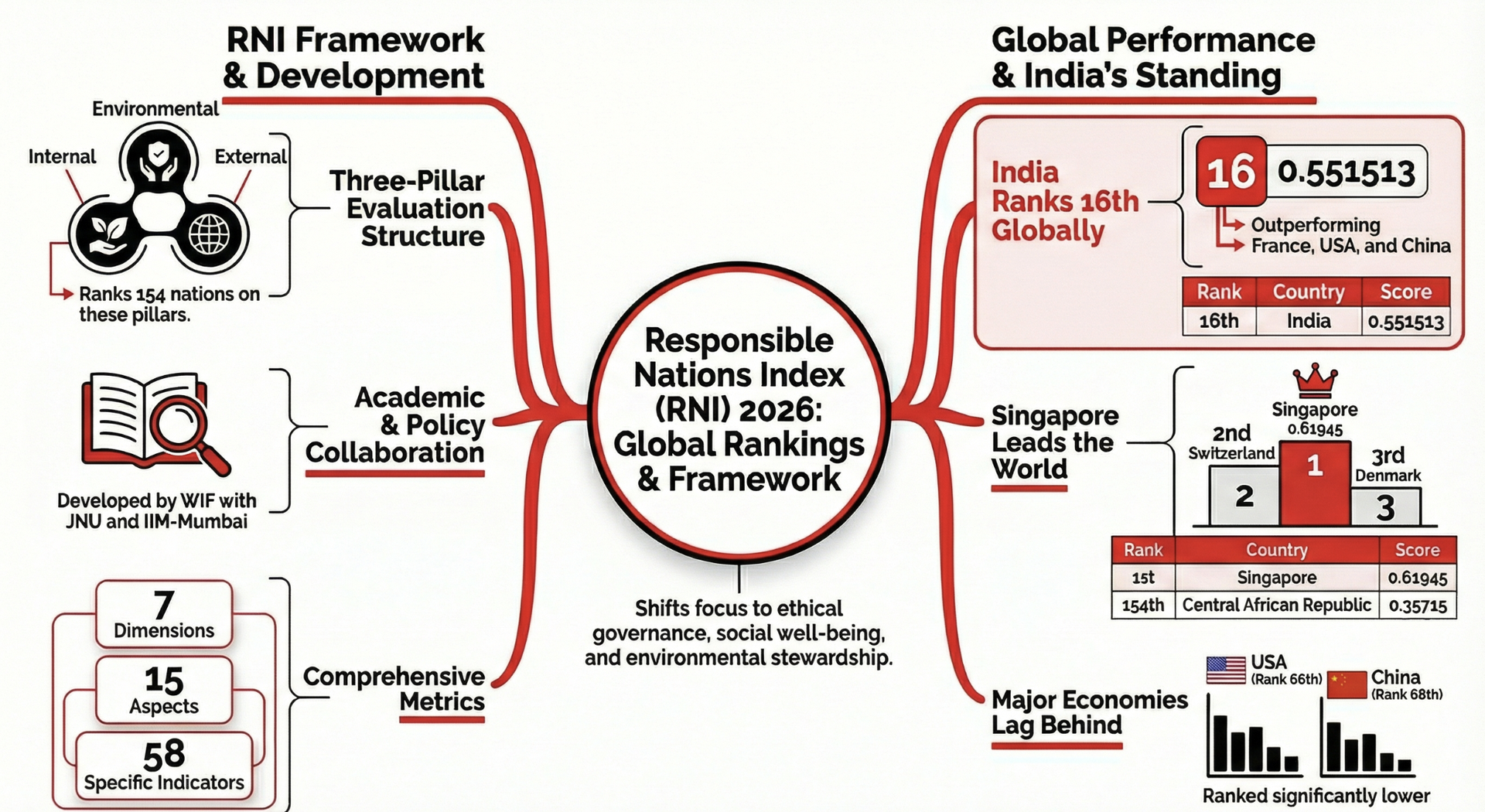
Launched in January 2026 by the Former President of India, Ram Nath Kovind, the Responsible Nations Index (RNI) represents a paradigm shift in global assessment. Traditionally, the "strength" of a nation has been measured by its Gross Domestic Product (GDP) or the size of its military. The RNI, however, challenges this convention by evaluating nations through the lens of ethical accountability and global citizenship.
Definition: The Responsible Nations Index is a comprehensive analytical framework designed to rank countries based on their ethical governance and commitment to the collective global good, prioritizing these values over traditional metrics of economic or military power.
The RNI evaluates a nation's conduct across four specific areas:
- Ethical Governance: Transparency, fairness, and the integrity of national leadership.
- Social Well-being: The provision of dignity, empowerment, and quality of life for all citizens.
- Environmental Stewardship: The degree of institutional commitment to ecological preservation.
- Global Responsibility: A nation's contributions and constructive behavior within the international community.
To truly understand how this index redefines national success, we must examine the specific value-based "pillars" that form its foundation.
2. The Three Pillars of National Responsibility
The RNI architecture is built upon three core pillars. These pillars ensure that a nation is assessed holistically—considering its duties to its own people, its impact on the physical world, and its standing as a member of the global family.
Pillar Name | Core Focus (The "What") | Primary Beneficiary/Outcome (The "Who/So What") |
Internal Responsibility | Obligations regarding the dignity, empowerment, and well-being of the population. | The Individual Citizen |
Environment Responsibility | Commitment to ecological protection and the pursuit of sustainable development. | The Planet and Future Generations |
External Responsibility | A nation’s behavior, contributions, and participation within the global system. | The International Community |
These pillars are not merely abstract concepts; they are supported by a rigorous mathematical and academic framework designed for objective measurement.
3. The Framework: Dimensions, Aspects, and Indicators
The RNI employs a structured hierarchy to translate the three pillars into measurable data points. This transparency allows policymakers and students to identify exactly where a nation succeeds or falters.
3 Pillars (Internal Responsibility, Environment Responsibility, External Responsibility)
7 Dimensions (Thematic areas of measurement)
- Quality of Life
- Governance
- Social Justice and Empowerment
- Economic Performance
- Environmental Protection
- Commitment to Peace
- International Economic Relations
15 Aspects (Sub-categories refining the dimensions)
- 58 Indicators (Granular data points used to calculate final scores)
This structured data allows for a clear ranking of nations across the globe, providing a detailed landscape of national responsibility in 2026.
4. Global Performance Landscape: 2026 Rankings
The inaugural RNI analyzed a total of 154 countries. The results reveal that high-income status does not guarantee a high responsibility ranking, as smaller, governance-focused nations dominated the top tier.
The Leaders: Top 3 Performers
Rank | Country | Overall Score |
1 | Singapore | 0.61945 |
2 | Switzerland | 0.58692 |
3 | Denmark | 0.58372 |
The Laggards: Bottom 3 Countries (Total Sample: 154)
Rank | Country | Overall Score |
152 | South Sudan | 0.37389 |
153 | Syria | 0.37254 |
154 (Lowest) | Central African Republic | 0.35715 |
Analysis: The European Dominance The Top 10 list—which includes Cyprus (4th), Sweden (5th), Czechia (6th), Belgium (7th), Austria (8th), Ireland (9th), and Georgia (10th)—is heavily populated by Northern and Eastern European nations. This regional success is driven by three primary factors:
- Robust Rule of Law: Consistent legal frameworks that ensure accountability.
- Inclusive Welfare Systems: Strong social safety nets that prioritize citizen dignity.
- Long-term Climate Action: Institutionalized commitments to environmental sustainability.
While Europe performs strongly, the index provides surprising insights into how major global powers and emerging economies like India compare on these ethical metrics.
5. Spotlight on India and Major Economies
A critical finding of the RNI 2026 is the performance of India relative to other global giants. India’s ranking demonstrates that emerging economies can compete with, and even exceed, the responsibility scores of established superpowers.
- India’s Standing: India secured the 16th spot globally with an overall score of 0.551513.
- Regional Context: In achieving the 16th rank, India outperformed several prominent European nations, including France, Albania, and Poland.
Responsibility vs. Economic Power: A Comparison The table below illustrates the disparity between traditional economic influence and "National Responsibility" as defined by the RNI.
Country | RNI Rank | Traditional Economic Status |
India | 16 | Major Emerging Economy |
Japan | 38 | Major Advanced Economy |
USA | 66 | Global Superpower |
China | 68 | Global Superpower |
This data highlights a core theme of the index: massive economic output does not automatically translate to ethical governance or social justice. The institutions responsible for these findings emphasize that this data is the result of long-term academic validation.
6. Institutional Context and Methodology
The RNI is the culmination of a three-year academic and policy research initiative. It was developed to provide a credible, data-driven alternative to GDP-centric rankings.
The Developers:
- World Intellectual Foundation (WIF): The lead think tank based in New Delhi. It was established in 2021 and is currently chaired by Prof. Jagdish Mukhi.
- Jawaharlal Nehru University (JNU): The primary academic partner.
- Indian Institute of Management (IIM)-Mumbai: Provided rigorous methodological validation.
Data Sources: To ensure academic integrity, the index synthesized data from recognized global entities, including:
- The World Bank (WB)
- United Nations Agencies: Including the IMF, WHO, FAO, and ILO.
- The World Justice Project
Methodological Note: While the index was launched in 2026, it utilizes the latest available data as of 2023. This three-year window is a standard mark of academic validity, allowing the developers to process, verify, and validate complex data across 58 indicators for 154 different nations.
7. Summary of Key Takeaways
- Redefining National Success: The RNI establishes that a "Responsible Nation" is defined by its ethical treatment of its citizens, its proactive protection of the environment, and its constructive participation in global affairs, rather than its military or economic might.
- The Rise of Emerging Economies: The 2026 results prove that emerging nations can lead the way in responsibility. India’s 16th-place ranking shows that these economies can excel in specific areas such as peacekeeping, renewable energy adoption, and inclusive welfare delivery, even when compared to larger powers like the USA (66th).
- A Holistic Measurement System: National responsibility is a multi-dimensional commitment. The RNI’s three-pillar system ensures that a country cannot be considered a leader if it succeeds in one area (such as the economy) while failing in another (such as environmental stewardship or internal social justice).