
Renaming Kerala to “Keralam”: A Comprehensive Guide for Competitive Exam Preparation
In a significant move toward linguistic decolonization and cultural alignment, the Union Cabinet has recently approved a proposal to officially rename the state of Kerala to “Keralam.” This change is to be formalized through the Kerala (Alteration of Name) Bill, 2026.
The initiative follows a resolution unanimously passed by the Kerala Legislative Assembly in 2024. The objective is to achieve total linguistic consistency by ensuring the state is referred to as "Keralam" not only in the First Schedule of the Constitution but across all 22 official languages recognised in the Eighth Schedule.
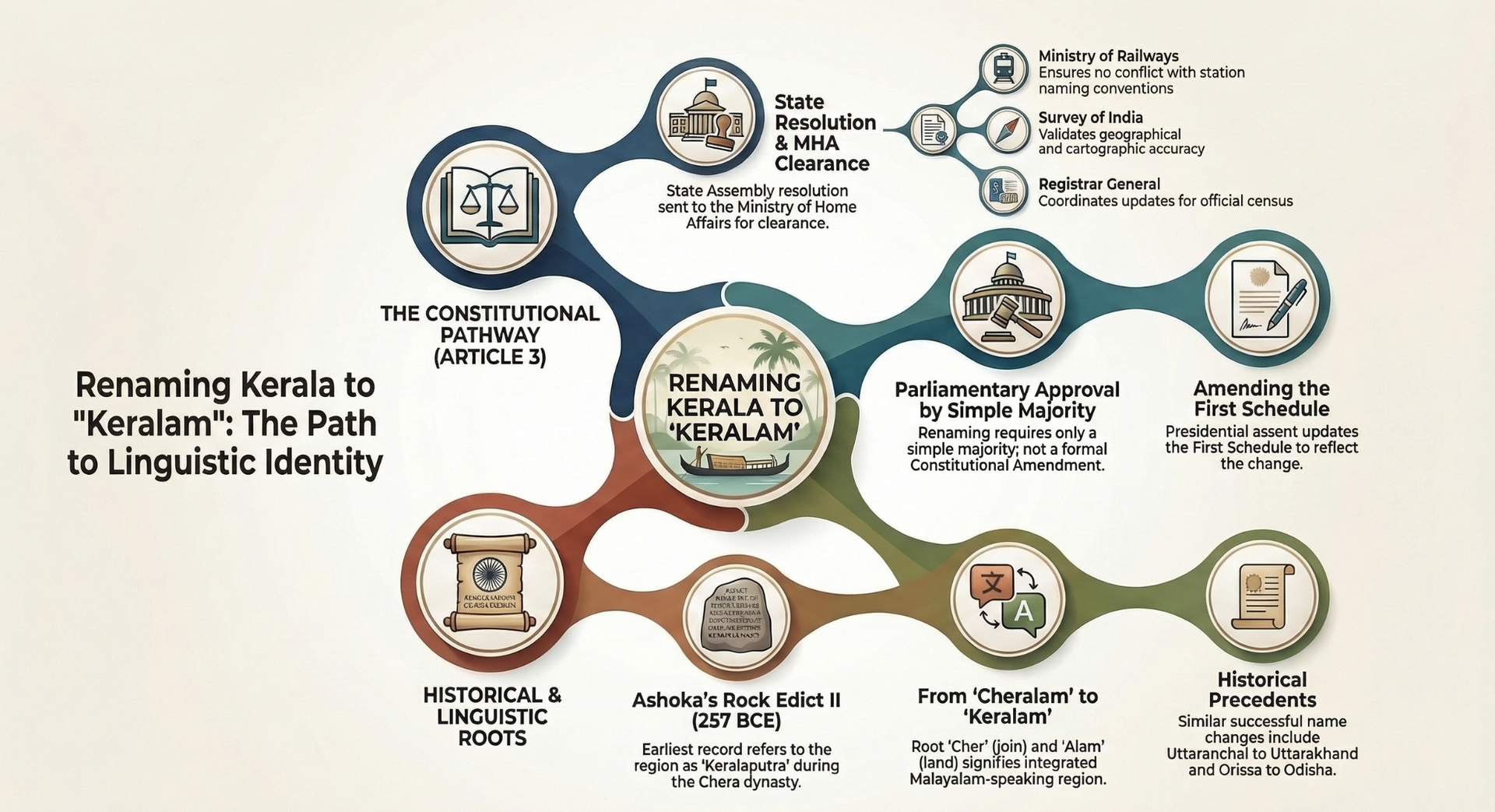
The Constitutional Mechanism: Article 3 Explained
Under the Indian Constitution, the power to alter the name, area, or boundaries of an existing state is an internal matter governed by Article 3. This provides Parliament with the authority to reorganize the domestic political map of the Union.
Step-by-Step Procedure for Renaming a State
- State Assembly Resolution: The process originates at the state level, where the Legislative Assembly passes a resolution and forwards it to the Ministry of Home Affairs (MHA).
MHA Clearance (The Nodal Ministry): As the nodal ministry for state reorganizations, the MHA coordinates the proposal. It must obtain No Objection Certificates (NOCs) from several central agencies to ensure no administrative or security conflicts. Key agencies include:
- Ministry of Railways
- Intelligence Bureau (IB)
- Department of Posts
- Survey of India
- Registrar General of India
- Ministry of Law and Justice: The Department of Legal Affairs and the Legislative Department must review and concur with the legal drafting of the proposal.
- Prior Recommendation of the President: According to Article 3, a Bill for renaming a state can only be introduced in either House of Parliament on the prior recommendation of the President.
- Reference to the State Legislature: Before introduction, the President refers the draft Bill to the concerned State Legislature to express its views within a specified timeframe.
- Non-Binding Nature of Views: The views of the State Legislature are consultative. Parliament is not bound by these views and may proceed with the Bill regardless of whether the state agrees or suggests modifications.
- Parliamentary Approval: The Bill must be passed by a Simple Majority (more than 50% of the members present and voting) in both the Lok Sabha and the Rajya Sabha.
- Presidential Assent and Amendment: Once the President grants assent, the Bill becomes an Act. This results in the formal amendment of the First Schedule (listing State names and territories) and, in this specific case, the Eighth Schedule (to ensure consistency across languages).
CRITICAL CONCEPT: While this process results in a change to the text of the Constitution (the First Schedule), it is not considered a constitutional amendment under Article 368. It is treated as a law passed by a simple majority under the ordinary legislative process.
Historical and Etymological Evolution
The transition to "Keralam" is an effort to reclaim the region's ancient and linguistic identity.
- Ancient Roots: The earliest epigraphic reference to the region appears in Emperor Ashoka’s Rock Edict II (257 BCE), which mentions "Keralaputra," identifying the land with the Chera dynasty.
- Linguistic Roots: Renowned scholar Herman Gundert derived "Keralam" from the terms "Cheram" or "Cheralam." The root word "cher" means "to join," and "alam" means "land" or "region." Historically, this denoted the integrated land extending from Gokarnam to Kanyakumari.
- Political Evolution (The Aikya Kerala Movement): In the 1920s, the Aikya Kerala Movement gained momentum, advocating for a unified state for all Malayalam speakers. After independence, the State Reorganisation Commission (SRC), chaired by Syed Fazl Ali, recommended the formation of the state on linguistic grounds.
- The 1956 Formation and Discrepancy: On 1st November 1956 (Kerala Piravi Day), the modern state was created by integrating the Malabar district and Kasargod taluk. Crucially, the reorganization excluded certain southern taluks of Travancore, which were merged with Tamil Nadu. Despite the native preference for "Keralam," the anglicized version "Kerala" was officially entered into the First Schedule at that time.
Key Constitutional Facts for Quick Revision
Feature | Detail |
Constitutional Provision | Article 3 |
Nodal Ministry | Ministry of Home Affairs (MHA) |
Schedule Affected (Territories) | First Schedule |
Schedule Affected (Linguistic) | Eighth Schedule |
Authority | Parliament of India |
Majority Required | Simple Majority |
Historical Precedents | Uttaranchal to Uttarakhand (2007); Orissa to Odisha (2011) |
Conclusion
The renaming of Kerala to Keralam is more than a nomenclature shift; it is a constitutional exercise to align India’s legal framework with its linguistic and historical heritage across all languages of the Eighth Schedule.
Exam Tip: For Indian Polity, master the distinction between External vs. Internal Reorganisation.
- Article 2 deals with External Reorganization (admission or establishment of new states that were not previously part of India).
- Article 3 deals with Internal Reorganisation (changing the name, area, or boundaries of states already existing within the Indian Union).