
Introduction
On April 10, 2026, the Supreme Court of India issued a landmark judgment reaffirming that the rights to vote and to contest elections are statutory rights rather than fundamental rights. Presided over by Justices B V Nagarathna and R Mahadevan, the Court established that these rights exist solely through legal permission and can be regulated, restricted, or removed by the legislative frameworks that created them. The ruling reversed a previous decision by the Rajasthan High Court, significantly limiting the scope of writ jurisdiction over cooperative societies and reinforcing the legal autonomy of non-State organizations to govern their internal electoral procedures.
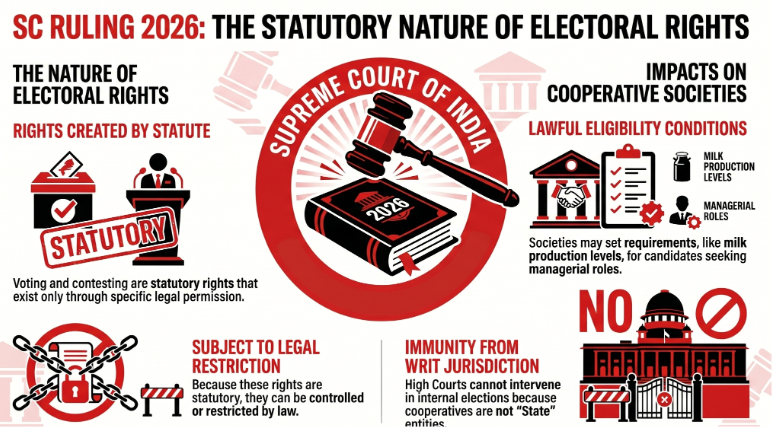
Detailed Analysis of Key Themes and Legal Principles
1. Classification of Electoral Rights as Statutory
The core of the Supreme Court's ruling lies in the constitutional distinction between fundamental and statutory rights. The Court clarified that participating in elections, both as a voter and a candidate, is not an inherent right protected under the fundamental rights chapter of the Constitution.
Legal Origin: These rights are products of specific laws (statutes).
Legislative Control: Because they are statutory, the legal framework that established them has the authority to control, restrict, or entirely withdraw these rights without violating constitutional law.
Conditional Participation: Participation in the elections of statutory bodies is a matter of legal permission rather than a constitutional guarantee.
2. Case Background: Rajasthan Dairy Cooperative Dispute
The ruling originated from a dispute involving the District Milk Producers' Cooperative Unions in Rajasthan. The unions had implemented specific bye-laws governing the eligibility of members wishing to contest elections for managing committees.
Contested Eligibility Requirements:
Minimum milk production levels for candidates.
Maintaining an active business status within the cooperative.
Procedural History: Specific members challenged these bye-laws in the Rajasthan High Court, which originally nullified the requirements. The Supreme Court's 2026 decision completely reversed the High Court’s ruling, reinstating the validity of the cooperative's eligibility conditions.
3. Validity of Bye-Laws and Delegated Legislation
The Supreme Court upheld the right of cooperative unions to set internal standards for their leadership through bye-laws.
Legal Consistency: The Court found that the eligibility conditions were established via the parent cooperative statute, making the bye-laws valid forms of delegated legislation.
Logical Relationship: The Court determined there was a logical relationship between the requirements (milk supply and operational continuity) and the objectives of the cooperative society.
Standards for Validity: Internal requirements are legally sound as long as they originate from a primary legal document and do not impose "nonsensical conditions."
4. Limits of Judicial Oversight and Article 12
A significant portion of the ruling addressed the limits of High Court intervention in the internal matters of cooperatives. The Supreme Court found the Rajasthan High Court's exercise of writ jurisdiction to be flawed based on the definition of "the State."
Non-State Status: Cooperative societies do not qualify as "State" entities under Article 12 of the Constitution because they do not perform public duties.
Jurisdictional Restrictions: Because cooperatives are not State entities, they are generally not subject to writ jurisdiction. The Court emphasized that High Courts should refrain from intervening in the internal electoral processes of non-State organizations.
Implications and Conclusions
The 2026 ruling provides a clear constitutional interpretation that balances accountability with organizational autonomy.
Feature | Legal Determination |
Right to Vote/Contest | Statutory (Legally permitted), not Fundamental. |
Cooperative Societies | Not "State" entities under Article 12. |
High Court Role | Prohibited from using writ jurisdiction for internal cooperative matters. |
Bye-law Authority | Lawful as long as they align with the parent statute and serve organizational goals. |
The decision serves as a protective measure for Indian cooperative societies, ensuring they maintain the legal power to establish eligibility requirements for their democratic processes. It sets a critical precedent for judicial restraint, affirming that internal matters of non-State organizations must remain outside the reach of constitutional writ jurisdiction unless they violate the overarching legal framework.