
Introduction
In April 2026, the Supreme Court of India, led by Chief Justice Surya Kant, issued a notice regarding a Public Interest Litigation (PIL) that seeks to extend the fundamental right to education under Article 21A to children aged three to six years. Currently, the constitutional mandate for free and compulsory education is limited to the six-to-fourteen age group, a bracket established by the 86th Constitutional Amendment Act of 2002.
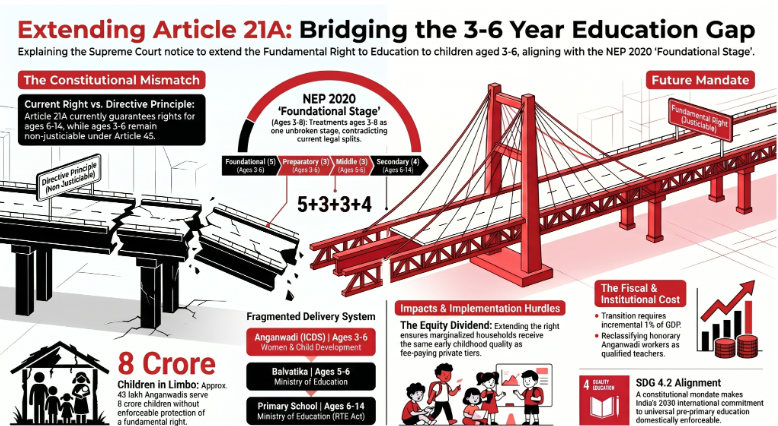
The core of the issue lies in the growing misalignment between India’s constitutional architecture and its modern policy framework. While the National Education Policy (NEP) 2020 identifies the ages of three to eight as a singular "foundational stage" for human capital formation, the first three years of this stage remain relegated to the non-justiciable Directive Principles of State Policy. The proposed extension seeks to bridge this gap, ensuring that early childhood care and education (ECCE) carries an enforceable statutory guarantee. However, such a shift presents significant fiscal, institutional, and legal challenges, including an estimated recurring cost of over one percent of GDP and the need to reconcile the roles of the Ministry of Education and the Ministry of Women and Child Development.
Current Legal and Constitutional Framework
The right to education in India has transitioned from an aspirational goal to an enforceable fundamental right through a series of judicial and legislative milestones.
Judicial Precedents
Mohini Jain v. State of Karnataka (1992): The Supreme Court initially read the right to education into the right to life under Article 21.
J.P. Unnikrishnan v. State of Andhra Pradesh (1993): The Court refined this right, limiting the State's obligation to provide free education to children up to the age of fourteen.
Constitutional and Statutory Provisions
The 86th Constitutional Amendment Act, 2002 established the current tri-part structure for education:
Article 21A: Created a fundamental right to free and compulsory education for children aged 6 to 14.
Article 45 (Revised): A Directive Principle urging the State to provide ECCE for all children until they complete the age of six.
Article 51A(k): Added a fundamental duty for parents to provide educational opportunities to children in the 6–14 age group.
The Right of Children to Free and Compulsory Education (RTE) Act, 2009, which became operational on April 1, 2010, serves as the legislative vehicle for Article 21A.
The Policy Landscape: NEP 2020 and Mission POSHAN 2.0
The PIL argues that the "frozen" nature of Article 21A fails to account for the restructuring of the Indian education system under recent policies.
The 5+3+3+4 Design: NEP 2020 replaced the old 10+2 system. The Foundational Stage now covers an unbroken five-year span for children aged three to eight.
Curriculum Alignment: The National Curriculum Framework for Foundational Stage (NCFFS) 2022 provides a play-based learning design for this entire age bracket.
Mission POSHAN 2.0: Launched in 2021, this mission integrates the Integrated Child Development Services (ICDS) and pushes for "Saksham Anganwadis" and "Balvatikas" (pre-school sections attached to primary schools).
Existing Pre-School Delivery Models
Provider | Oversight | Target Demographic |
Anganwadi Centres (ICDS) | Ministry of Women & Child Development (MoWCD) | 3–6 years; focused on nutrition and pre-school components. |
Balvatikas | Ministry of Education (MoE) | 5–6 years; pre-Class 1 in government schools. |
Private Pre-schools | Unregulated | Fee-paying urban populations. |
NGO Centres | State-aligned | Often serve first-generation learners. |
Arguments for the Extension of Article 21A
The move to expand the right to education from age three is driven by several critical factors:
Addressing the Learning Crisis: ASER 2023 and the National Achievement Survey (NAS) 2021 report significant learning losses. Over 50% of Indian 10-year-olds are unable to read simple text (World Bank "learning poverty" metric). Proponents argue that universal foundational literacy and numeracy (NIPUN Bharat) targets are impossible to meet without an enforceable right starting at age three.
The Equity Dividend: Vulnerable populations (SC, ST, and migrants) rely almost exclusively on Anganwadis. A rights-based guarantee would reduce the "first-contact" learning gap that impacts lifetime outcomes.
Administrative Convergence: A constitutional mandate would force the MoE and MoWCD to reconcile disparate standards for teacher qualifications, infrastructure, and assessments.
International Alignment: Extending the right aligns with Sustainable Development Goal (SDG) 4.2, which calls for universal access to quality early childhood development and pre-primary education by 2030.
Challenges and Concerns
The proposed extension faces substantial hurdles that are both fiscal and structural in nature.
Fiscal and Institutional Barriers
Financial Burden: Universalizing the RTE teacher-pupil ratio (30:1) and upgrading 43 lakh Anganwadis would require a recurring incremental cost estimated at over 1% of GDP.
Workforce Reclassification: Anganwadi workers are currently "honorary workers." Reclassifying them as pre-primary teachers would necessitate alignment with National Council for Teacher Education (NCTE) rules and trigger complex litigation regarding pay parity and pension status.
Quality Risk: Critics warn that extending the RTE framework (including its no-detention aspects) without a dedicated ECCE quality framework might entrench the learning crisis rather than solve it.
Constitutional Objections
There is a concern regarding judicial overreach. Article 21A contains precise age language (six to fourteen). Critics argue that reading this to include age three is a judicial rewriting of a provision where Parliament explicitly chose to keep the younger age bracket within the Directive Principles.
Global Context
India remains an outlier among comparable economies regarding the exclusion of pre-primary years from fundamental rights.
Country | Compulsory Education Age | Pre-primary Status |
France | 3–16 | Compulsory pre-primary since 2019. |
United Kingdom | 5–16 | Free early education starting at age 3. |
Brazil | 4–17 | Compulsory from age 4. |
South Africa | 7–15 | Universal "Reception year" (Grade R). |
India | 6–14 | Pre-primary is a non-enforceable Directive Principle. |
Strategic Recommendations for Implementation
To bridge the gap between policy intent and constitutional reality, the following steps are suggested:
Legislative Action: Pursue a constitutional amendment to redefine the age bracket in Article 21A as three to fourteen years, ensuring Parliament remains the center of the fiscal commitment.
Unified Framework: The Ministry of Education should publish a single Foundational Stage Operational Framework applicable to both MoE Balvatikas and MoWCD Anganwadis.
Cadre Reclassification: Implement a five-year phased plan to reclassify Anganwadi workers into a pre-primary educator stream with NCTE-aligned qualifications.
Dedicated Funding: NITI Aayog should recommend a specific Finance Commission grant window for pre-primary universalisation, earmarked under Samagra Shiksha 2.0.
Oversight: Designate the National Commission for Protection of Child Rights (NCPCR) as the grievance redressal body for pre-primary entitlements, mirroring its current role for the 6–14 age group.
Monitoring: Launch an annual Foundational Stage Quality Index, disaggregated by district and demographic status, to be published alongside ASER and NAS data.