
Introduction
In April 2026, a five-judge Constitution Bench of the Supreme Court delivered a landmark verdict clarifying the status of cooperative societies under Article 12 of the Indian Constitution. The ruling addresses whether these societies, registered under state Cooperative Societies Acts, qualify as "the State," a designation that determines if their actions can be challenged via writ jurisdiction for fundamental rights violations.
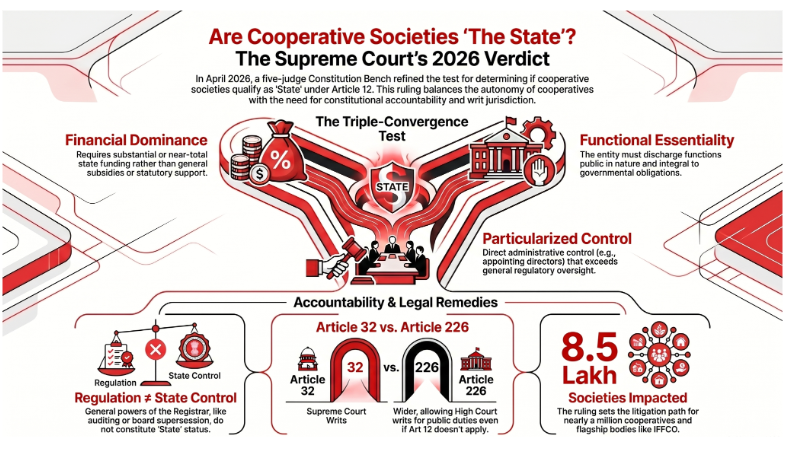
The Court moved away from mechanical checklists, refining the "cumulative functional test." For a cooperative society to be considered "State," three elements must now converge: financial dominance by the government, functional essentiality to public obligations, and particularised administrative control. While most state-level cooperatives will fall outside this definition, the ruling preserves the "safety valve" of Article 226, allowing High Courts to issue writs if a society discharges a public duty. This judgment seeks to balance the autonomy of the cooperative sector with constitutional accountability, impacting over 8.5 lakh societies and flagship entities like IFFCO and KRIBHCO.
Constitutional Framework and Judicial Evolution
The Definition of "State"
Under Article 12, "the State" includes the Government and Parliament of India, state governments and legislatures, local authorities, and "other authorities." The interpretation of "other authorities" determines the reach of fundamental rights. Only entities qualifying as "State" are subject to writ jurisdiction under Article 32 for fundamental rights violations.
Judicial Precedents
The April 2026 ruling represents the latest evolution in a decades-long judicial dialogue:
Rajasthan State Electricity Board v. Mohan Lal (1967): Established that statutory bodies performing public functions qualify as "State."
Ajay Hasia v. Khalid Mujib Sehravardi (1981): Introduced a "six-factor test," including criteria such as entire share capital held by the government, deep and pervasive control, and functions of public importance.
Pradeep Kumar Biswas v. Indian Institute of Chemical Biology (2002): A seven-judge Bench moved toward a "cumulative functional test," arguing that the Ajay Hasia factors were illustrative rather than exhaustive. It emphasized whether a body was financially, functionally, and administratively dominated by the government.
Zee Telefilms v. Union of India (2005): Clarified that even bodies performing public functions (like the BCCI) are not "State" if they lack deep governmental control.
The April 2026 Judgment: The Restated Test
The Supreme Court has now refined the requirements for a cooperative society to be classified as "State" under Article 12. The ruling mandates that a society is only an instrumentality of the State when the following three elements converge:
Financial Dominance: Substantial or near-total state funding. This must go beyond mere subsidies or statutory support available to all societies.
Functional Essentiality: The society must discharge functions that are public in nature and integral to governmental obligations, such as the distribution of essential commodities, public health, or credit to farmers.
Particularised Administrative Control: This includes powers such as the appointment of directors, the power of supersession, and specific audit powers that exceed the general regulatory framework of the Cooperative Societies Act.
Regulation vs. Control
The Court drew a sharp distinction between general regulation and particularised control. Powers held by the Registrar of Cooperative Societies to inspect accounts or call for returns are considered regulatory and applicable to all societies; such powers do not, by themselves, transform a society into a "State" entity.
Impact on Specific Entities and Jurisdictions
Multi-State vs. State-Registered Societies
The ruling creates different tiers of scrutiny based on the nature of the cooperative:
Multi-State Cooperatives: Entities like IFFCO and KRIBHCO will receive closer scrutiny. Where the Union government holds equity or uses the society as a primary channel for public distribution or procurement, they may be treated as "State" for those specific functions.
State-Registered Societies: Most, including large federations like Amul (GCMMF), will generally fall outside the scope of Article 12 unless the three-fold test of dominance and control is met.
Article 32 vs. Article 226
The judgment clarifies the path of litigation for aggrieved parties:
Feature | Article 32 (Supreme Court) | Article 226 (High Courts) |
Requirement | Entity must qualify as "State" under Article 12. | Entity must discharge a public duty or function of public importance. |
Scope | Narrower; limited to Fundamental Rights. | Wider; reaches "any person or authority" for various purposes. |
Application | Not available for most cooperative disputes. | Available as a "safety valve" for public function claims. |
Employee and Member Disputes: Purely private disputes, such as service matters, share allotments, or dividends, remain outside writ jurisdiction. These must be addressed through Cooperative Tribunals, the Registrar, or civil courts.
Significance and Systemic Impact
Legal and Doctrinal Clarity
The ruling provides a single binding test, ending inconsistent High Court outcomes where some benches applied the Ajay Hasia factors mechanically while others used the Pradeep Biswas approach.
Respect for Federalism
By refusing to categorize all state-registered societies as "State," the Court respects the autonomy of the cooperative sector and the legislative competence of states under List II, Entry 32 of the Constitution. This aligns with the 2021 ruling in Union of India v. Rajendra N. Shah, which limited the application of the 97th Amendment's Part IXB to multi-state cooperatives.
Litigation Discipline
The decision is expected to reduce the "docket pressure" on High Courts by establishing a clearer threshold for writ petitions. Thousands of cases involving cooperative banks and credit societies will now be screened against the refined three-fold test.
Concerns and Future Challenges
Despite the clarity provided, several challenges remain:
Fact-Intensive Inquiries: Determining if funding is "substantial" or control is "particularised" requires a case-by-case analysis, which may lead to divergent findings in lower courts.
Access to Justice: While Article 226 exists as a remedy, legal aid in rural areas is often thin, and statutory tribunals can be slow.
The "Democratic Deficit": Following the partial invalidation of Part IXB in 2021, state-level cooperatives lack a uniform constitutional floor for matters like board tenure and reservations (SC/ST/Women) unless specifically legislated by individual states.
The Regulatory Thin Line: In sectors like cooperative banking, the overlapping roles of the RBI and State Registrars create a complex environment where the line between "regulation" and "control" remains thin.
Proposed Way Forward
To implement the spirit of the 2026 ruling, the following measures are suggested:
Framework Development: The Ministry of Cooperation should publish a framework to help distinguish regulatory powers from operational control.
Legislative Action: Parliament should consider a new constitutional amendment, using the Article 252 consultation mechanism, to restore a minimum democratic floor for state cooperatives.
Institutional Strengthening: State Registrars should be empowered as quasi-judicial authorities with fixed timelines to reduce the burden on writ courts.
Grievance Redressal: The RBI and NABARD should issue joint circulars on grievance redressal for cooperative bank depositors to ensure effective remedies remain available outside of writ jurisdiction.
Ombudsman Feasibility: The Law Commission of India may examine the creation of a statutory ombudsman for the cooperative sector to bridge the access gap for Article 226 remedies.