
Introduction
The March 2026 draft amendments to the Information Technology (Intermediary Guidelines and Digital Media Ethics Code) Rules, 2021 (IT Rules 2021), represent a fundamental shift in India's digital regulatory landscape. Moving beyond administrative adjustments, these changes transition the state’s role from reactive content removal to the proactive shaping of digital discourse.
The amendments expand executive oversight to include individual users and influencers, transform the Inter-Departmental Committee (IDC) into a surveillance body, and compress takedown timelines to as little as one hour. By bypassing parliamentary oversight and existing judicial stays, the framework establishes what is described as "structural authoritarianism", an environment where the architecture of digital communication is engineered to favor executive control over independent participation and dissent.
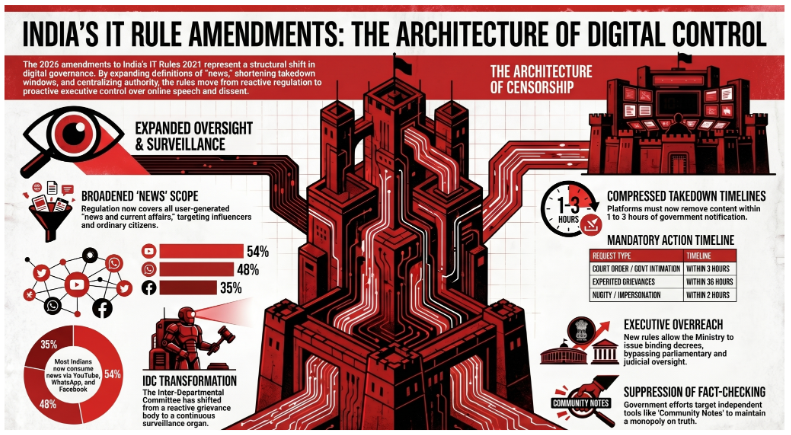
Expansion of Regulatory Oversight to Individual Users
The amended Rule 8(1) significantly widens the net of government oversight by bringing user-generated "news and current affairs content" under the regulatory framework of Part III of the IT Rules.
Key Implications of Rule 8(1)
Indiscriminate Scope: The definition of "user" includes everyone from high-reach influencers to ordinary citizens. There are no qualitative or quantitative thresholds (such as follower counts or reach) to limit who falls under this category.
Vague Definitions: The term "news and current affairs content" remains undefined. This lack of clarity allows the state to draw a vast array of expressions, including satire, policy analysis, cultural critique, and personal documentation, into a formal oversight structure.
Circumvention of Judicial Authority: These amendments were introduced while the constitutional validity of Part III remains under judicial review. By expanding these rules, the executive effectively bypasses stay orders previously issued by the Bombay and Madras High Courts regarding the Code of Ethics and grievance redressal mechanisms.
Context: The Role of Independent Creators
As traditional media ownership becomes increasingly concentrated among corporate groups with political proximity, independent digital creators have become vital sources of pluralism.
Digital News Consumption: 71% of Indians rely on online media for news, with high consumption on YouTube (54%), WhatsApp (48%), and Facebook (35%).
Influencer Reach: Creators like Dhruv Rathee (31 million subscribers) and Ravish Kumar (14.5 million subscribers) provide alternative commentary that the new rules now seek to regulate.
Transformation of the Inter-Departmental Committee (IDC)
The IDC has evolved from a reactive body meant to address specific grievances into a proactive instrument of continuous surveillance.
Structural Changes to the IDC
Feature | Previous Framework | 2026 Amended Framework |
Role | Reactive; initiated by identifiable complaints. | Proactive; can consider any "matter" referred by the Ministry. |
Membership | Dominated by government representatives. | Remains government-dominated, lacking independence. |
Powers | Limited to examining breaches of the Code of Ethics. | Can recommend warnings, censure, apologies, and content modification. |
Discretion | Constrained by initiating grievances. | Unconstrained; permits ongoing scrutiny without contesting voices. |
Enforcement of the Code of Ethics
Through the IDC, the state can now compel individual users to comply with the Code of Ethics, which incorporates the 1995 Programme Code. This allows the government to demand content modifications or apologies based on vague standards such as "morality," "taste," and "social harmony."
The Architecture of Censorship: Timelines and Tools
The amendments and accompanying guidance from the Ministry of Electronics and Information Technology (MeitY) create an operational environment where platforms are incentivized to over-censor to avoid legal liability.
Compressed Takedown Timelines
The government has introduced stringent windows for intermediaries to act upon receiving "actual knowledge" of content violations:
Court/Government Orders: 3 hours.
Expedited Grievances: 36 hours.
Sensitive Content (Nudity/Impersonation): 2 hours.
Proposed Future Standard: Reduction to a 1-hour timeline.
Intermediaries that fail to meet these deadlines risk losing their "safe harbor" immunity under Section 79 of the IT Act, effectively forcing platforms to prioritize immediate removal over contextual assessment.
Centralized Control Mechanisms
Sahyog Regime: A centralized mechanism for issuing takedown requests that bypasses the procedural safeguards of Section 69A of the IT Act (which requires reasoned orders and review).
Rule 3(4): This new rule grants MeitY the power to issue binding "clarifications, advisories, and standard operating procedures (SOPs)." This allows for governance by executive decree, bypassing parliamentary oversight.
Decentralized Blocking: Proposals are under consideration to grant direct takedown authority to multiple individual ministries.
Targeting Dissent and Fact-Checking
Recent enforcement patterns suggest a calibrated focus on political satire and content challenging official narratives.
Targeted Content and Accounts
Scale of Removal: Between January and June 2025, content removals on Meta platforms increased by nearly 300% compared to 2023.
Political Targets: Between March 11 and 24, 2026, account-level restrictions targeted satire from the Congress party, The Wire’s musical parodies, and cartoons by Satish Acharya.
Specific Issues: Content restricted often relates to treatment of minorities, international conflicts, and domestic crises like the LPG shortage.
Control Over "Truth"
The executive is increasingly moving to monopolize fact-checking:
PIB Fact Check Unit (FCU): Despite judicial rulings suggesting such units are unconstitutional, the government continues to use the Press Information Bureau to coordinate content removal with intermediaries.
Community Notes: The government has sought to bring user-driven features like X’s "Community Notes" under regulatory ambit, particularly after notes were appended to posts by BJP leaders and the Prime Minister. If platforms are held liable for user-led fact-checking, they may disable these features, removing a key tool for collective scrutiny.
Conclusion: Structural Authoritarianism
The 2026 amendments indicate that control is no longer exercised solely through direct intervention, but through the very architecture of the digital ecosystem. By creating a high-speed, executive-led regulatory rhythm that outpaces judicial scrutiny, the state has recalibrated the public sphere. "Safety" and "Accountability" are redefined as mechanisms of discipline, moving the internet away from a space of independent contestation toward a model of pre-emptive compliance and state-coordinated discourse.