
Introduction
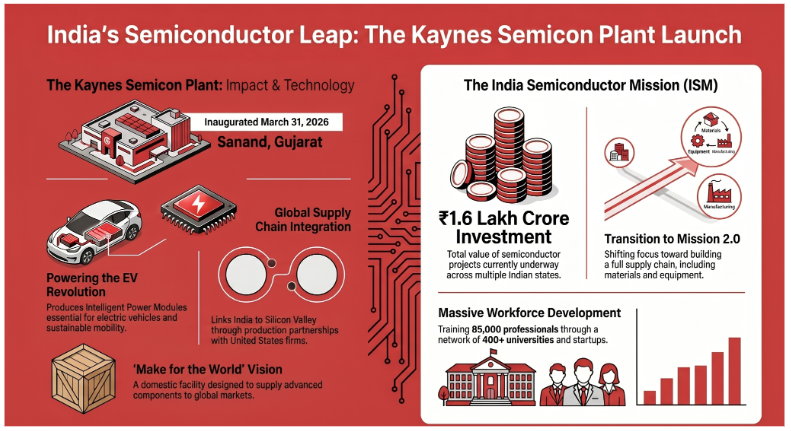
On March 31, 2026, Prime Minister Narendra Modi inaugurated the Kaynes Semicon Plant in Sanand, Gujarat, marking a significant milestone in the India Semiconductor Mission. The facility represents a shift toward domestic chip production and positions India as a reliable alternative in the global semiconductor supply chain. Producing critical components such as Intelligent Power Modules (IPMs), the plant supports high-growth sectors including electric vehicles (EVs) and industrial automation.
This development is part of a broader national strategy involving over ₹1.6 lakh crore in ongoing projects. The government is currently transitioning to "Semiconductor Mission 2.0," which seeks to build a comprehensive supply chain, including raw materials and equipment, while simultaneously investing in human capital to train 85,000 industry professionals.
The Kaynes Semicon Plant: Strategic Significance
The inauguration of the Kaynes Technology facility in Sanand is a primary driver in India's ambition to become a global technology leader. The plant is not an isolated project but a cornerstone of a rapidly expanding national ecosystem.
Key Operational Impacts
Domestic Production: The facility initiates the domestic manufacturing of advanced semiconductor components, reducing the nation’s historical reliance on chip imports.
Import Substitution: By establishing local manufacturing, the plant strengthens India's self-reliance in high-tech sectors.
Strategic Location: Its placement in Sanand, Gujarat, reinforces the region’s role as a hub for the India Semiconductor Mission.
Integration into Global Supply Chains
The Kaynes facility operates under the "Make in India, Make for the World" vision, focusing on high-quality manufacturing intended for both domestic use and international export.
Global Partnerships: The facility has established active collaborations with firms in the United States, directly connecting Indian manufacturing to Silicon Valley supply chains.
Reliability: By participating in global markets, India aims to establish itself as a dependable partner in the international semiconductor ecosystem.
Export Potential: A significant portion of the plant's output is earmarked for global markets, specifically focusing on the export of Intelligent Power Modules (IPMs).
Technological Applications and Emerging Industries
The plant's output focuses on Intelligent Power Modules, which are essential for modernizing energy and transport infrastructure.
Sector | Application and Support |
Electric Vehicles (EVs) | Enabling sustainable mobility and advanced vehicle electronics. |
Industrial Automation | Powering heavy machinery and automated manufacturing systems. |
Energy Efficiency | Providing components for advanced, energy-efficient electronics. |
Evolution of the India Semiconductor Mission
The India Semiconductor Mission (ISM), launched in 2021, has evolved from an initial design and manufacturing push into a multi-phased national strategy.
Progress and Investment
Financial Commitment: Projects totaling more than ₹1.6 lakh crore are currently underway across various Indian states.
Mission 2.0: This next phase broadens the scope of the ISM to include the entire supply chain, specifically focusing on the production of essential materials and manufacturing equipment.
Workforce and Innovation Development
To sustain this growth, the government has implemented several programs focused on talent and innovation:
Professional Training: A target has been set to train 85,000 semiconductor professionals to meet industry demand.
The "Chips to Startup" Program: An initiative designed to support new ventures and entrepreneurs in the semiconductor space.
Academic Integration: More than 400 universities and various innovators are currently participating in the development of the semiconductor ecosystem.
Conclusion
The launch of the Kaynes Semicon plant serves as a tangible manifestation of India’s commitment to tech-led industrial growth. By bridging the gap between domestic manufacturing and global demand, and by scaling from Mission 1.0 to 2.0, the country is attempting to secure a permanent and critical position in the global high-tech landscape.