
Introduction
The Jan Vishwas (Amendment of Provisions) Bill, 2026, represents a landmark legislative shift in India’s regulatory framework, transitioning from a punitive governance model to one rooted in trust. Passed by the Lok Sabha, the Bill aims to significantly enhance the Ease of Doing Business (EoDB) and Ease of Living by decriminalizing minor offenses across a vast spectrum of Central Acts. By replacing criminal prosecution with civil penalties and introducing a "warning-first" principle, the legislation seeks to reduce the burden on the judiciary while fostering a predictable, transparent, and fair environment for stakeholders. The Bill is the result of an extensive consultative process involving high-level committees and industry experts.
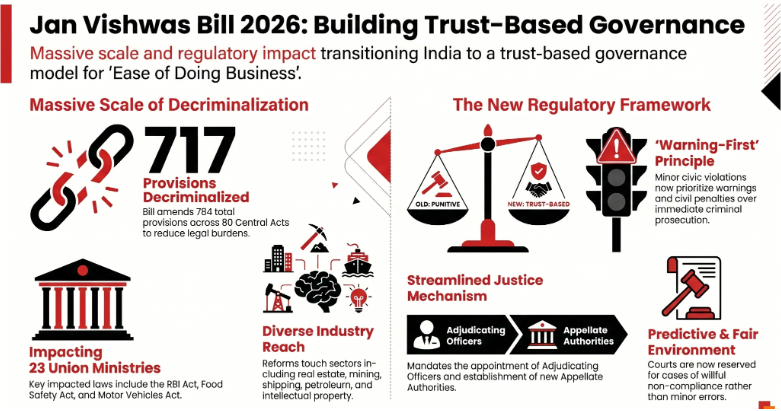
Overview of Legislative Scope
The Bill is comprehensive in scale, targeting a wide array of regulations administered by nearly two dozen ministries. The following table summarizes the quantitative impact of the legislation:
Category | Scale of Impact |
Total Provisions Amended | 784 |
Total Central Acts Affected | 80 |
Ministries Involved | 23 |
Provisions Decriminalized | 717 |
Targeted Sectors and Acts
The amendments span critical sectors of the economy and public life. Key laws scheduled for amendment include:
Financial and Commercial: Reserve Bank of India Act, 1934; Copyright and Patents laws.
Safety and Infrastructure: Food Safety and Standards Act, 2006; Motor Vehicles Act, 1988; Railways Act.
Industrial and Energy: Laws governing Coal, Mining, Petroleum, and Power.
Logistics: Shipping and Real Estate regulations.
Core Themes and Regulatory Shift
Transition to Trust-Based Governance
The central philosophy of the 2026 Bill is the movement away from criminalizing minor civic violations. The legislation operates on the principle that the regulatory environment should be supportive rather than strictly punitive. By decriminalizing 717 provisions, the government intends to remove the "fear of imprisonment" for technical or minor lapses, thereby encouraging compliance through trust rather than coercion.
Decriminalization and Civil Penalties
A primary mechanism of the Bill is the replacement of criminal prosecution with civil penalties. This shift is characterized by:
Warning-First Principles: Prioritizing warnings for initial or minor infractions before moving to financial penalties.
Judicial Efficiency: Reserving the court system for cases of "willful non-compliance" rather than minor administrative errors.
Systemic Relief: Reducing the overall burden on the criminal justice system by diverting minor cases to administrative channels.
Institutional Framework for Dispute Redressal
To support the shift toward civil penalties, the Bill mandates the creation of a specialized institutional hierarchy:
Adjudicating Officers: Empowered to assess violations and impose civil penalties.
Appellate Authorities: Established to provide a structured mechanism for stakeholders to appeal the decisions of Adjudicating Officers.
Development and Consultative Process
The Jan Vishwas (Amendment of Provisions) Bill, 2026, was not developed in isolation but is the product of rigorous multi-stakeholder engagement:
High-Level Oversight: The Bill was shaped by meetings of a High-Level Committee under the auspices of NITI Aayog.
Select Committee Review: A dedicated Select Committee conducted 49 sittings to refine the provisions.
Expert Input: The process included extensive testimony and consultation with industry leaders and subject-matter experts to ensure the amendments aligned with market realities and the needs of the public.
Conclusion
The Jan Vishwas (Amendment of Provisions) Bill, 2026, serves as a significant intervention to modernize the Indian regulatory landscape. By stripping away outdated criminal penalties for minor offenses and establishing a robust administrative adjudication framework, the Bill aims to create a more efficient and business-friendly environment while maintaining accountability through transparent civil mechanisms.