
Introduction
In a strategic move to ensure the completion of vital rural infrastructure, the Union Cabinet, chaired by Prime Minister Narendra Modi, has approved the extension of the Pradhan Mantri Gram Sadak Yojana-III (PMGSY-III). Originally slated to conclude in March 2025, the program will now continue until March 2028, with specific components extended through March 2029. This extension is accompanied by an increased financial outlay of ₹83,977 crore, reflecting the government's commitment to consolidating and upgrading existing rural road networks. While PMGSY-III focuses on the modernization of through routes and major links to agricultural markets and social infrastructure, the government has concurrently launched PMGSY-IV to address the connectivity needs of 25,000 previously unconnected habitations.
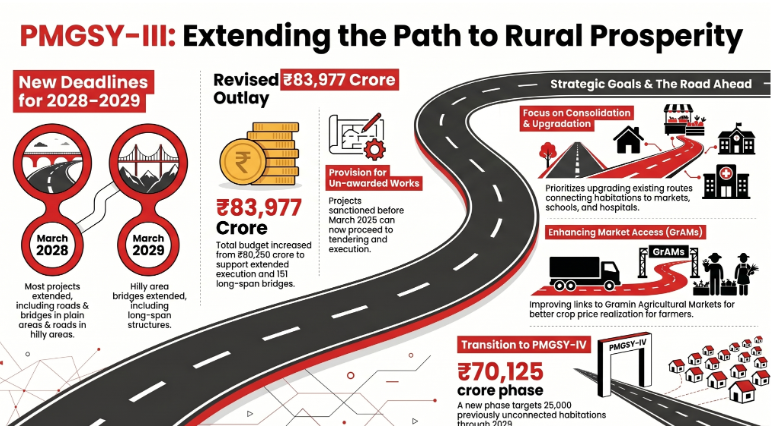
Analysis of Extended Timelines and Implementation Strategy
The Cabinet has sanctioned extended deadlines categorized by terrain and project complexity to facilitate the full implementation of the scheme’s targets. This staggered approach acknowledges the technical challenges inherent in infrastructure development, particularly in difficult geographies.
Terrain-Specific Deadlines
Plain Areas: The completion of both road and bridge projects has been extended to March 2028.
Hilly Areas (Roads): Road construction in mountainous regions is now scheduled for completion by March 2028.
Hilly Areas (Bridges): Due to the technical complexities involved in bridge construction in high-altitude or difficult terrains, a further extension has been granted until March 2029.
Un-awarded Works
A significant provision of this extension allows for the continuation of projects that were sanctioned before March 31, 2025, but had not yet been awarded. These works are now permitted to proceed to the tendering and execution phases, ensuring that previously approved infrastructure does not stall due to administrative deadlines.
Revised Financial Outlay and Resource Allocation
The extension of the implementation period necessitates an adjustment in the scheme's budget. The total financial commitment has been revised upward to accommodate both existing works and newly sanctioned components.
Expenditure Category | Original Outlay | Revised Outlay |
Total Scheme Budget | ₹80,250 crore | ₹83,977 crore |
Long Span Bridges (LSBs) | N/A | ₹961 crore (Estimated) |
Focused Infrastructure: Long Span Bridges (LSBs)
The revised plan includes the approval of 161 Long Span Bridges that were previously pending sanction. These bridges are critical for maintaining year-round connectivity in areas where standard road infrastructure is insufficient.
Core Objectives and Strategic Shift of PMGSY-III
Launched in 2019, Phase III of the PMGSY represents a paradigm shift in rural development strategy. Unlike earlier phases that prioritized the creation of new connectivity, PMGSY-III focuses on the consolidation and upgradation of the existing network.
Primary Targets for Upgradation
Through Routes and Major Rural Links: Enhancing the quality and durability of roads that serve as the backbone of rural transport.
Gramin Agricultural Markets (GrAMs): Facilitating better access to markets to assist farmers in achieving better price realization for their crops.
Social Infrastructure: Strengthening links to essential services, specifically focusing on Higher Secondary Schools and Hospitals to improve rural education and healthcare outcomes.
Complementary Expansion: PMGSY-IV
While PMGSY-III focuses on upgrading existing infrastructure, the government has introduced PMGSY-IV (covering the period 2024-25 to 2028-29) to address remaining connectivity gaps.
Objective: To provide all-weather road connectivity to 25,000 previously unconnected habitations.
Financial Outlay: ₹70,125 crore.
Relationship to Phase III: Phase IV runs parallel to the extended Phase III, ensuring a dual focus on both upgrading existing networks and expanding connectivity to isolated areas.