
Introduction
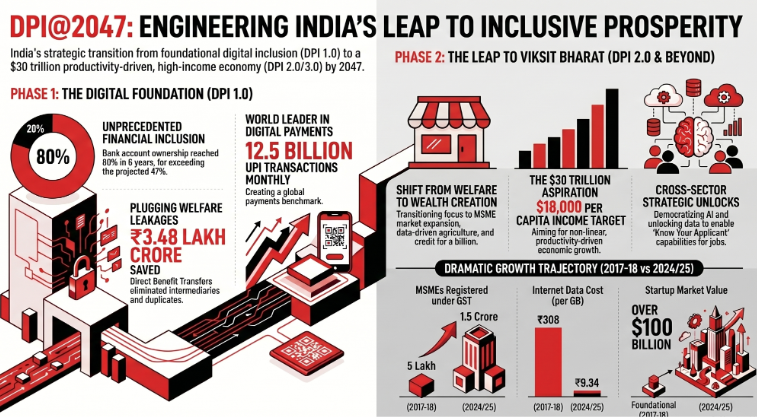
India’s vision for Viksit Bharat 2047 targets an audacious economic transformation: becoming a $30 trillion economy with a per capita income of $18,000. Achieving this necessitates a shift from the "foundational inclusion" of the last decade (DPI 1.0) to a "livelihood-led, productivity-driven" growth model (DPI 2.0).
Over the past 15 years, India’s Digital Public Infrastructure (DPI) approach,anchored by Aadhaar, UPI, and the JAM trinity,has demonstrated that shared digital building blocks can drive non-linear, "hockey-stick" growth. These systems have already onboarded over 1.3 billion people into digital identity and financial ecosystems, contributing nearly 1% of GDP today with a potential to reach 4.2% by 2030.
The DPI@2047 Roadmap outlines a strategic transition across two phases. DPI 2.0 (2025–2035) focuses on eight high-impact sectoral transformations,including MSMEs, agriculture, health, and education,designed to remove structural bottlenecks like high transaction costs and siloed data. The execution strategy rests on four imperatives: aggregating demand via district programs, scaling tech entrepreneurship, leveraging AI, and deploying cross-sector strategic unlocks. To initiate this, a decentralized, state-led execution plan is recommended, focusing initially on MSMEs and Agriculture during the 2026–2027 cycle.
I. Context: The Foundations of DPI 1.0
The journey of the last 15 years has established India as a global leader in public-purpose digital transformation. This phase, termed DPI 1.0, focused on welfare delivery and financial inclusion.
The "Hockey-Stick" Effect of Combinatorial Innovation
The power of India's approach lies in the synergistic interaction of shared capabilities:
The JAM Trinity (Jan Dhan, Aadhaar, Mobile): Achieved 80% bank account penetration in just eight years,a feat that traditionally would have taken 47 years.
Aadhaar e-KYC: Reduced customer acquisition costs significantly, enabling mobile ownership to surge to 85% by May 2025.
Unified Payments Interface (UPI): Transformed India into a global leader in real-time digital payments, bringing millions of micro-entrepreneurs into the formal economy.
Economic Streamlining: Initiatives like GST and FASTag created a unified national market, growing GST-registered MSMEs from 5 lakh in 2017 to 1.5 crore by late 2024.
Key Learnings for the Roadmap
Problem-First Approach: Solutions must solve specific, large-scale challenges (e.g., Aadhaar was designed to curb welfare leakages, not just provide technology).
Minimalist Shared Capabilities: Keeping digital building blocks minimal (like the UPI payment protocol) lowers friction and maximizes private-sector innovation.
Citizen-Centric Design: Adoption succeeds when it is rooted in existing behaviors (e.g., scanning a QR code).
Agile Institutional Setups: Success requires independent institutions (like NPCI or UIDAI) with a mix of public and private sector talent.
II. The Roadmap: DPI 2.0 (2025–2035)
The transition to DPI 2.0 seeks to move beyond service delivery to wealth creation by unlocking productivity and entrepreneurship at population scale.
Target Sectoral Transformations
The roadmap identifies eight sectors where DPI can remove structural bottlenecks:
Category | Sectoral Transformation | Core Objective |
Mass Inclusion at Scale | MSME Market Expansion | Widening market linkages and simplifying compliance via market intelligence. |
MSME Job Discovery | Making jobs and local talent digitally visible to lower transaction costs. | |
Smallholder Farmers | Improving livelihoods through data-driven advisory and fair value chains. | |
Foundations of Human Capability | Learner-Centric Education | Enabling equitable access to materials in local languages and continuous learning. |
Universal Health Coverage | Ensuring health crises do not erase family financial stability regardless of status. | |
Systemic Enablers | Access to Credit | Maximizing monetizable assets for microcredits for a billion Indians. |
Decentralized Energy | Effective utilization of renewable sources to meet growing energy needs. | |
Benefits finding Beneficiaries | Ensuring social benefits reliably reach all eligible citizens without friction. |
III. Execution Strategy for DPI 2.0
Achieving these transformations requires an intentional ecosystem-driven approach. The roadmap defines four interconnected imperatives.
1. Aggregate Demand via District Programs
To achieve the "compounding effect," adoption must be driven at the grassroots. District-level programs will link the DPI roadmap to local development goals, aggregating demand and providing a secure pipeline for tech entrepreneurs.
2. Scale Tech Entrepreneurship
India must expand its base of innovators who can deliver DPI-aligned services. This involves:
Incubators and accelerators.
Mission-focused R&D.
Policy and regulations that support distributed innovation engines.
3. Leverage AI Momentum
AI is viewed as a primary productivity engine. By making AI accessible through the DPI approach, India can solve complex, rooted systemic problems (e.g., removing language barriers for predictive intelligence).
4. Deploy Cross-Sector Strategic Unlocks
Common structural bottlenecks, such as siloed data and high costs of trust,will be addressed through four strategic unlocks:
Unlocking Data: Enabling insights and credential proofs in a low-cost, high-trust manner.
Democratizing AI: Ensuring accessibility for predictive intelligence and personalized guidance.
Enhancing Human Capacity: Removing barriers to knowledge and technical expertise.
Expanding Digital Transactions: Unbundling supply and demand through open networks and digital enablement.
IV. Call to Action: Recommended Action Plan
The transition to DPI 2.0 must begin immediately to maintain momentum toward 2047.
Decentralized State-Led Execution: The Government of India and NITI Aayog should act as catalysts, while individual States lead implementation to ensure local context and ownership.
Collaborative 2-Year Iterative Cycles:
First Cycle (2026-2027): Focus on MSMEs and Agriculture.
Phase 1: Six champion States/UTs implement lighthouse pilots in the first year.
Phase 2: At least five additional States/UTs roll out proven transformations in the second year.
Institutional Support: MeitY and NITI Aayog should constitute an expert advisory group and engage DPI organizations to support state-led initiatives.
Global Engagement Body: By 2027, India should establish a neutral initiative housed in a global body to spearhead collaboration on DPI and AI for the public good, cementing India’s role as a global leader in digital transformation.
"India’s DPI approach stands as a powerful, proven foundation for inclusive, resilient, and sustainable growth. It positions us not just to meet our national aspirations, but to offer the world a replicable pathway for equitable digital transformation." - S. Krishnan, Secretary, MeitY