
Introduction
The Delhi state government has officially launched the Lakhpati Bitiya Yojana, a comprehensive financial assistance program designed to support the education and long-term financial security of girl children from birth through higher education. Announced via a gazette notification on March 30, 2026, the scheme replaces the previous Ladli Scheme. Under the leadership of Chief Minister Rekha Gupta, the program provides phased financial aid that can accumulate to approximately ₹1.20 lakh with interest. The initiative targets economically weaker sections (EWS) and aims to mitigate social challenges such as child marriage while improving female literacy and workforce participation.
Program Overview and Objectives
The Lakhpati Bitiya Yojana is a strategic intervention by the Delhi government to ensure that financial constraints do not hinder a girl's educational journey or social empowerment.
Core Objectives
Educational Promotion: Encouraging girls to pursue education from primary school through graduation and professional diplomas.
Social Reform: Actively working to prevent early marriages by linking financial maturity to age and educational milestones.
Economic Empowerment: Ensuring long-term financial independence for women from economically disadvantaged backgrounds.
Support for Vulnerable Families: Reducing the financial burden on families within the economically weaker sections of society.
Financial Assistance Framework
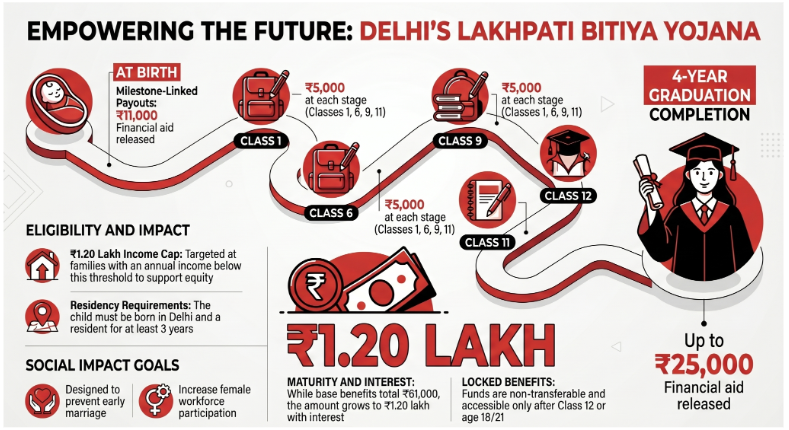
The scheme provides a structured payout system where funds are deposited at specific educational milestones. While the cumulative base benefit reaches ₹61,000, the total amount matures to approximately ₹1.20 lakh including interest.
Breakdown of Financial Milestones
Milestone | Financial Assistance Amount |
At Birth | ₹11,000 |
Class 1 | ₹5,000 |
Class 6 | ₹5,000 |
Class 9 | ₹5,000 |
Class 11 | ₹5,000 |
Class 12 | ₹5,000 |
1-Year Diploma Completion | ₹10,000 |
2-3 Year Diploma Course Completion | ₹20,000 |
4-Year Graduation Course Completion | Up to ₹25,000 |
Withdrawal Conditions
To ensure the funds are used for their intended purpose of empowerment, the following restrictions apply:
Funds are deposited in phases but cannot be accessed early.
The beneficiary can only withdraw the matured amount after completing Class 12 and attaining either 18 or 21 years of age.
Eligibility and Application Requirements
The scheme is strictly targeted at residents of Delhi who meet specific socioeconomic criteria.
Eligibility Criteria
Birth and Residency: The girl must be born in Delhi, and the family must have been residents of the state for at least three years.
Income Limit: The annual family income must not exceed ₹1.20 lakh.
Family Cap: Benefits are limited to a maximum of two girl children per family.
Educational Requirement: The beneficiary must be enrolled in a school recognized by the Delhi government.
Application and Verification Process
The implementation process is designed to be digital and transparent:
Registration: Applicants must register via a dedicated online portal.
Documentation: Submission of birth certificate, residence proof, income certificate, and proof of school admission is mandatory.
Approval: The District Women and Child Development Officer is responsible for the verification and final approval of all applications.
Special Provisions and Governance
The Lakhpati Bitiya Yojana includes specific clauses to handle various contingencies and ensure the integrity of the funds.
Flexibility in Registration: Late registration is permitted at key educational stages, such as at the time of school admission.
Institutional Support: Girls residing in child care institutions may be eligible for relaxed enrollment conditions.
Non-Transferability: Benefits are non-transferable and intended solely for the registered beneficiary.
Death Clause: In the event of the beneficiary's death, the accumulated amount is returned to the state government.
Anticipated Social Impact
The scheme is positioned as a tool for deep-seated social change rather than just a financial grant. By incentivizing education and delaying marriage, the Delhi government expects to see:
Increased female literacy rates across the state.
Higher participation of women in the professional workforce.
A significant reduction in the prevalence of child marriage.
A shift in the perception of the girl child among economically weaker sections.