
Introduction
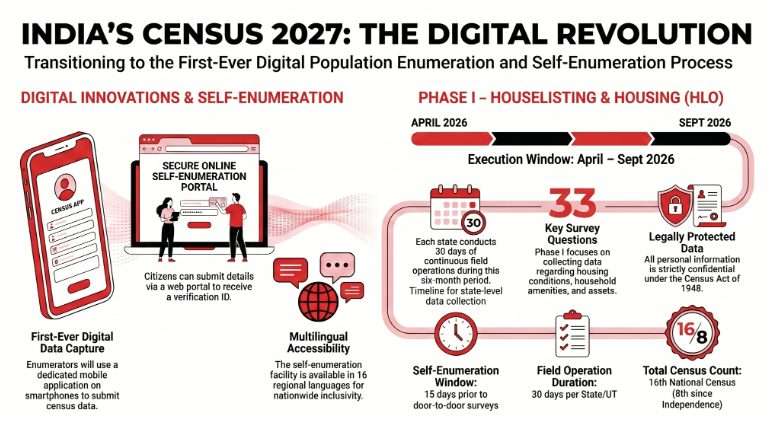
The Government of India has officially launched Phase I of Census 2027, marking a historic transition in the nation’s administrative capabilities. As the 16th Census overall and the 8th since Independence, this exercise is the world's largest population enumeration. Its primary distinction lies in being the first "fully digital" census, incorporating mobile application-based data collection and a robust self-enumeration facility for citizens. Phase I, the Houselisting and Housing Census (HLO), is currently underway, focusing on housing conditions and household amenities across specific initial rollout areas.
Historical and Administrative Significance
Census 2027 represents a critical milestone in India's demographic and social data collection efforts. It serves as the foundation for policy planning and national governance.
Enumeration Cycle: This is the 16th national census in India’s history and the 8th conducted following Independence.
Scale: It is recognized as the largest census exercise globally.
Inaugural Act: President Droupadi Murmu became the first citizen to complete the self-enumeration process, signifying the official commencement of the exercise.
The Digital Transformation
The shift from paper-based records to a digital-first approach is the defining feature of Census 2027. This modernization aims to streamline data capture and improve the accuracy of the information collected.
Key Digital Features
Mobile Application: For the first time, enumerators are equipped with smartphones to collect and submit data directly via a dedicated application.
Self-Enumeration Portal: Citizens can voluntarily submit their details through a secure web portal (se.census.gov.in).
Verification System: Upon completing self-enumeration, a Self-Enumeration ID (SE ID) is generated. This ID must be provided to the enumerator during their field visit for verification.
Linguistic Accessibility: To ensure inclusive participation, the self-enumeration facility is available in 16 regional languages.
Phase I: Houselisting and Housing Census (HLO)
Phase I focuses on the physical infrastructure and living standards of the population. This phase provides the framework for the subsequent population enumeration.
Operational Timeline
Activity | Schedule |
Phase I Window | April 1, 2026 – September 30, 2026 |
Field Operations | 30 days of continuous activity per State/UT within the window |
Self-Enumeration Window | A 15-day period provided immediately before door-to-door surveys |
Data Scope
During Phase I, enumerators and citizens are required to answer 33 notified questions. These questions are designed to gather comprehensive data on:
Housing conditions and structures.
Household amenities (such as water, electricity, and sanitation).
Ownership of household assets.
Initial Rollout and Participation
The digital and self-enumeration processes have seen immediate adoption in several key regions. On the first day of the facility's availability, approximately 55,000 households successfully utilized the self-enumeration option.
Initial Rollout Jurisdictions:
Andaman and Nicobar Islands
Goa
Karnataka
Lakshadweep
Mizoram
Odisha
Sikkim
New Delhi Municipal Council (NDMC) areas
Delhi Cantonment Board areas
Legal Framework and Data Privacy
The collection and storage of census data are governed by strict statutory requirements to protect citizen privacy.
Governing Legislation: All data collection is conducted under the Census Act, 1948.
Confidentiality: The Act ensures the strict confidentiality of personal information. Data collected during the census is legally protected and intended solely for demographic, social, and economic analysis to inform governance.