Introduction
The Ministry of Environment, Forest and Climate Change (MoEFCC) has notified the Solid Waste Management (SWM) Rules, 2026, a modernized regulatory framework set to take effect on April 1, 2026. Replacing the previous 2016 standards, these rules signify a fundamental shift in India’s waste policy, moving from a "collect-and-dump" model to a circular economy approach.
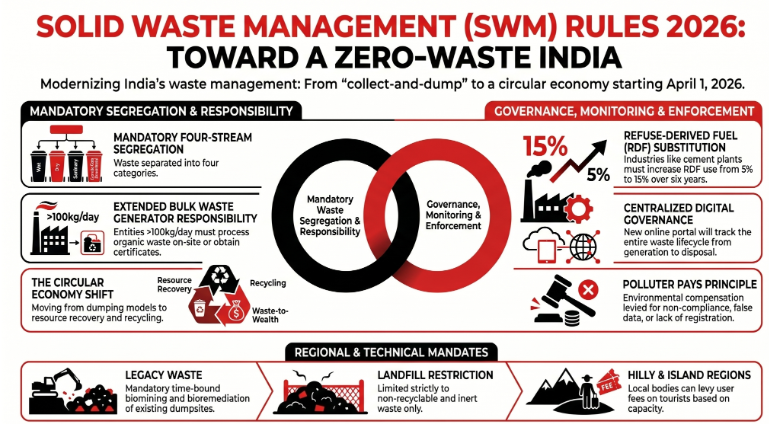
The primary objective is to achieve Zero Waste to Landfill through four-stream source segregation, increased accountability for bulk generators, and the integration of digital governance. Key innovations include the introduction of Extended Bulk Waste Generator Responsibility (EBWGR), mandatory Refuse-Derived Fuel (RDF) substitution in industries, and specific provisions for ecologically sensitive hilly and island regions.
Regulatory Framework and Objective
The SWM Rules, 2026, are issued under the legal authority of the Environment (Protection) Act, 1986. By superseding the 2016 framework, the new rules aim to:
Modernize India's waste management infrastructure.
Prioritize resource recovery and recycling over disposal.
Leverage digital tracking to ensure accountability throughout the waste lifecycle.
Key Features and Operational Mandates
1. Mandatory Four-Stream Segregation
To facilitate better recycling and processing, waste generators are now required to separate waste at the source into four distinct categories:
Waste Stream | Description | Disposal/Processing Method |
Wet Waste | Organic and food waste | Composting or bio-methanation |
Dry Waste | Plastic, paper, and metal | Material Recovery Facilities (MRFs) |
Sanitary Waste | Diapers and napkins | Must be wrapped securely for separate handling |
Special Care Waste | Domestic hazardous items (paint, bulbs, medicines) | Specialized handling and disposal |
2. Extended Bulk Waste Generator Responsibility (EBWGR)
The 2026 rules place a higher burden of responsibility on large-scale waste producers. Entities must process organic waste on-site or obtain EBWGR certificates if they meet any of the following criteria:
Generating more than 100 kg of waste per day.
Consuming more than 40,000 liters of water per day.
Occupying an area of more than 20,000 square meters.
3. Digital Governance and Tracking
A Centralised Online Portal will be established to modernize oversight. This platform will serve as the primary hub for:
Registration of waste management entities.
Reporting and lifecycle tracking of waste.
Conducting audits to ensure compliance.
4. Industrial Integration: Refuse-Derived Fuel (RDF)
The rules mandate a specific role for industries, such as cement plants, in the waste-to-energy pipeline. These industries are required to increase their use of RDF substitution from 5% to 15% over a six-year period.
Land Management and Environmental Remediation
Landfill Restrictions
The framework strictly limits the use of landfills, reserving them exclusively for non-recyclable and inert waste. This is a critical component of the "Zero Waste to Landfill" goal.
Legacy Waste Management
The rules address existing environmental hazards by mandating time-bound:
Biomining: The extraction of recyclables and soil from old waste.
Bioremediation: The use of biological processes to treat contaminated sites.
Infrastructure and Allocation
To accelerate the development of waste facilities, the rules provide:
Graded criteria for faster land allocation for processing units.
Mandatory buffer zones for large facilities to mitigate local impacts.
Regional and Economic Provisions
Hilly and Island Regions
Recognizing the unique logistical and ecological challenges of these areas, local bodies are granted specific powers:
Tourist User Fees: Authority to levy fees on tourists to fund waste management.
Inflow Regulation: The ability to regulate the inflow of people based on the region's total waste processing capacity.
Polluter Pays Principle
To ensure enforcement, the rules introduce Environmental Compensation. Financial penalties will be levied for:
Operating without mandatory registration.
Submitting false data to the centralized portal.
General non-compliance with the established framework.
Significance and Expected Impact
The implementation of the SWM Rules, 2026, is expected to yield significant environmental and economic benefits:
Emissions Reduction: By scientifically managing landfills and remediating legacy sites, the rules aim to reduce methane emissions, a potent greenhouse gas.
Pollution Prevention: Remediation efforts will help prevent the contamination of soil and groundwater.
Waste to Wealth: By fostering a circular economy, the framework seeks to transform waste into valuable resources, including compost, energy, and recycled raw materials.