
Introduction
On March 28, 2026, Prime Minister Narendra Modi officially inaugurated Phase I of the Noida International Airport (NIA) in Jewar, Uttar Pradesh. Situated along the Yamuna Expressway in Gautam Buddha Nagar, this greenfield project serves as the second international gateway for the Delhi-National Capital Region (NCR). Developed under a Public-Private Partnership (PPP) model by Yamuna International Airport Private Limited (YIAPL), a subsidiary of Zurich Airport International AG, the facility is designed to alleviate congestion at Indira Gandhi International Airport (IGI) and bolster India’s status as a global aviation hub. With an initial investment of approximately ₹11,200 crore, the airport combines advanced navigation technology, substantial passenger capacity, and a commitment to net-zero emissions.
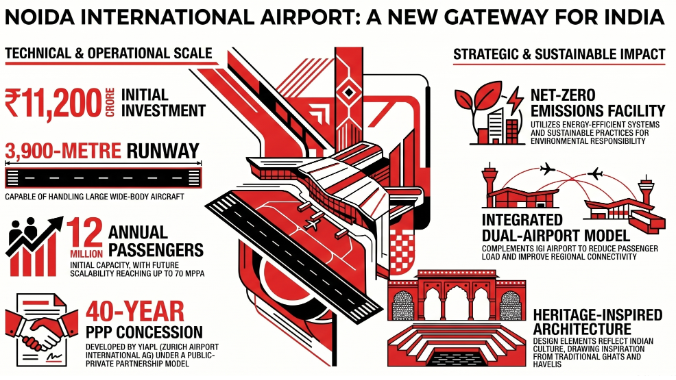
Strategic Importance and Regional Connectivity
The Noida International Airport is a critical component of a dual-airport strategy for the National Capital Region. By operating alongside IGI Airport, NIA is positioned to create an integrated aviation system that optimizes passenger traffic management.
Congestion Relief: The primary objective is to reduce the passenger load on existing infrastructure while improving overall operational efficiency in the region.
Regional Accessibility: Its location on the Yamuna Expressway provides high-speed access for travelers from Delhi, Noida, Greater Noida, and surrounding districts.
Economic Impact: The airport is expected to strengthen domestic and international connectivity, acting as a catalyst for regional development and global trade integration.
Regulatory Framework and Operational Status
The transition from construction to operation was marked by the acquisition of necessary regulatory approvals and the establishment of long-term management agreements.
Licensing: The Directorate General of Civil Aviation (DGCA) has granted the aerodrome license to YIAPL.
Classification: The airport is certified under the "public use" category, authorizing it for all-weather and round-the-clock operations.
Management: The project operates under a 40-year concession period which commenced in October 2021. The development is led by YIAPL, leveraging the expertise of Zurich Airport International AG.
Technical Specifications and Infrastructure
Phase I of the airport has been engineered to support high-capacity, modern aviation requirements.
Feature | Specification / Detail |
Initial Investment | Approximately ₹11,200 crore |
Runway Length | 3,900 metres |
Aircraft Compatibility | Capable of handling wide-body aircraft |
Current Capacity | 12 million passengers per annum (MPPA) |
Scalability | Expandable up to 70 MPPA in future phases |
Navigation Systems | Instrument Landing System (ILS) and modern airfield lighting |
The inclusion of advanced navigation infrastructure ensures that the airport can maintain operations during adverse weather conditions, ensuring reliability for international and domestic carriers.
Sustainable Design and Architectural Vision
The Noida International Airport is designed to balance modern industrial requirements with environmental responsibility and cultural heritage.
Net-Zero Emissions: The facility is designed as a net-zero emissions airport, integrating energy-efficient systems and sustainable operational practices from its inception.
Cultural Identity: The architectural philosophy draws inspiration from traditional Indian elements. Specifically, the design reflects the aesthetics of Indian ghats and havelis, blending regional heritage with state-of-the-art infrastructure.
Future Vision: The project represents a commitment to environmental stewardship while building the high-capacity infrastructure necessary to meet the projected growth in Indian aviation demand.