
Introduction
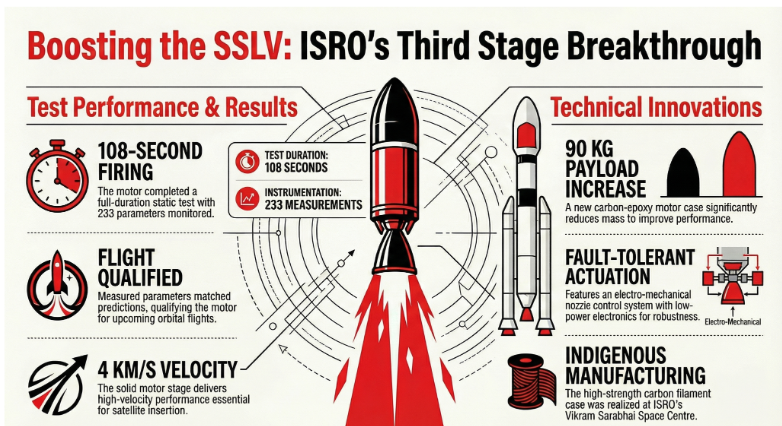
On December 30, 2025, the Indian Space Research Organisation (ISRO) successfully conducted a static ground test of an improved third stage (SS3) for its Small Satellite Launch Vehicle (SSLV). Performed at the Satish Dhawan Space Centre (SDSC) in Sriharikota, the test validated several critical design enhancements, most notably the implementation of a Carbon-epoxy Motor case. This material advancement significantly reduces the stage's inert mass, resulting in a 90 kg increase in the SSLV’s payload performance.
The test duration of 108 seconds confirmed the efficiency of new igniter and nozzle systems, as well as fault-tolerant control electronics. This successful qualification of the SS3 motor marks a pivotal step in ISRO’s strategy to establish the SSLV as a rapid-response, industrially producible launcher. Furthermore, the year 2025 saw a major expansion in India’s solid motor production infrastructure, including the commissioning of the world’s largest vertical mixer and increased chemical production capacities to support growing mission demands.
Overview of the Small Satellite Launch Vehicle (SSLV)
The SSLV is designed as a three-stage, all-solid launch vehicle. Its primary operational objectives focus on commercial and strategic flexibility, characterized by:
Industrial Amenability: Designed for easy production by industry partners.
Launch-on-Demand: Capable of meeting rapid deployment requirements.
Quick Turn-around: Minimized time intervals between successive launches.
The third stage (SS3) is a critical component of this architecture, responsible for delivering a velocity of approximately 4 km/s to the launch vehicle.
Technical Specifications and Improvements of the SS3 Stage
The December 2025 ground test focused on an upgraded version of the SS3, introducing enhancements to the motor case, ignition, and control systems.
Material and Structural Advancements
The transition to a high-strength, carbon filament-wound motor case represents a significant technical milestone.
Carbon-epoxy Motor Case: Developed at the Composites Entity of the Vikram Sarabhai Space Centre (VSSC), this new case replaces older designs to reduce stage mass.
Payload Impact: The mass reduction directly translates to an additional 90 kg of payload capacity for the SSLV.
Nozzle Design: The stage utilizes a free-standing nozzle divergent designed to further limit inert mass.
System Efficiencies and Control
Igniter and Nozzle System: The redesigned system is characterized as more robust and efficient than previous iterations.
Nozzle Control: Implementation is handled through a fault-tolerant electro-mechanical actuation system.
Electronics: The system utilizes low-power control electronics to manage actuation.
Static Test Performance and Results
The static firing was conducted at the Solid Motor Static Test Facility at SDSC, Sriharikota. The performance was monitored through an extensive instrumentation suite.
Metric | Details |
Duration | 108 seconds |
Total Measurements | 233 independent parameters |
Key Parameters Captured | Pressure, thrust, temperature, vibration, control electronics, and actuator performance |
Outcome | All parameters observed were close to pre-test predictions |
Conclusion of Test: The successful firing has officially qualified the improved SS3 motor for induction into future SSLV flights.
Strategic Infrastructure Expansion in 2025
The success of the SS3 test is supported by a broader national effort to increase solid motor production capacity. Several key facilities were commissioned or upgraded throughout 2025:
Production Capacity (July 2025): New Solid Motor production facilities were commissioned at Sriharikota to augment existing output.
Chemical Production (September 2025): A second production line for Ammonium Perchlorate was opened at the Alwaye plant, doubling the production capacity of this essential solid motor component.
Technological Milestones: ISRO commissioned an indigenous 10-tonne vertical mixer at SDSC. This equipment is currently the world’s largest solid propellant mixing apparatus.
Casting Facilities: The solid motor for the SS3 test was cast at the specialized Solid Motor production facilities at SDSC.
Support for the Commercial Space Ecosystem
Beyond its internal programs, ISRO’s infrastructure at SDSC is being utilized to support the burgeoning Indian private space sector. The Solid Motor Production & Static Testing facilities were recently used to realize and test a solid motor for the first orbital launch of a launch vehicle developed by an Indian space start-up. This indicates a shift toward using national facilities to bolster both sovereign and commercial space capabilities.