
Introduction
On January 29, 2026, the Indian Navy and the Japan Maritime Self-Defence Force (JMSDF) convened in New Delhi for the 11th edition of their bilateral Staff Talks. This high-level engagement aimed to solidify maritime cooperation, enhance operational interoperability, and align strategic visions within the Indo-Pacific region. The discussions emphasized a shared commitment to a "Free and Open Indo-Pacific" and explored expanded avenues for cooperation, including equipment sharing and personnel exchanges. This meeting took place against a backdrop of increasing bilateral engagement, underscored by the recent visit of Japanese Foreign Minister Toshimitsu Motegi to India.
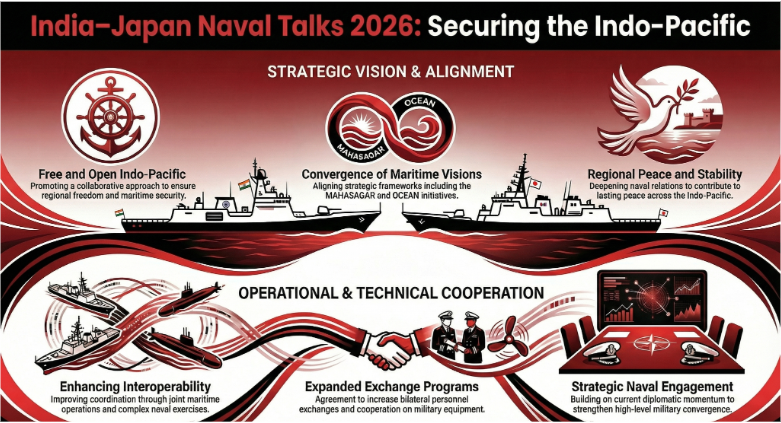
Overview of the 11th Naval Staff Talks
The meeting served as a critical platform for naval leadership from both nations to coordinate on security challenges and operational goals.
Attribute | Details |
Date | January 29, 2026 |
Location | New Delhi, India |
Participants | Indian Navy and Japan Maritime Self-Defence Force (JMSDF) |
Edition | 11th Staff Talks |
Primary Objective | Strengthening maritime cooperation, interoperability, and coordination |
Strategic Alignment and Regional Vision
A central theme of the talks was the promotion of a stable and secure maritime environment. Both nations expressed a unified stance on several strategic frameworks:
Free and Open Indo-Pacific: The talks reinforced the collaborative approach necessary to maintain a free, open, and inclusive Indo-Pacific region.
Convergence of Maritime Visions: There was a specific focus on building synergy between India and Japan’s respective maritime frameworks, notably:
MAHASAGAR: India’s initiative for collective maritime security and growth.
OCEAN: Collaborative maritime efforts supported by Japan.
Regional Stability: The JMSDF emphasized that deepening naval relations with India is a fundamental contributor to peace and stability across the broader Indo-Pacific.
Enhancing Operational Interoperability
To move beyond theoretical alignment, the talks identified practical measures to improve how the two navies work together:
Coordinated Operations: Both sides explored strategies to enhance coordination during active maritime operations.
Joint Exercises: The talks aimed to refine and increase the complexity of bilateral maritime exercises to ensure seamless integration during real-world scenarios.
Technical Interoperability: Discussions included measures to improve the technical and procedural compatibility between the Indian Navy and the JMSDF.
Expanded Areas of Bilateral Cooperation
The 11th edition of the Staff Talks marked an evolution in the partnership, with the JMSDF highlighting agreements to broaden the scope of engagement:
Equipment Cooperation: Exploring the sharing and development of maritime equipment and technology.
Personnel Exchanges: Increasing the frequency and depth of exchanges between naval officers and specialists to foster mutual understanding and professional development.
Operational Synergies: Moving toward more integrated operational planning and execution.
Broader Strategic Context
The naval talks are a component of a larger, intensifying diplomatic relationship between India and Japan. The strategic significance of these talks is highlighted by:
High-Level Diplomacy: The recent visit of Japanese Foreign Minister Toshimitsu Motegi to India signifies a period of heightened strategic engagement between the two nations.
Strategic Convergence: The talks demonstrate an increasing overlap in the national security interests of New Delhi and Tokyo, particularly regarding maritime domain awareness and the maintenance of international law at sea.