
Introduction
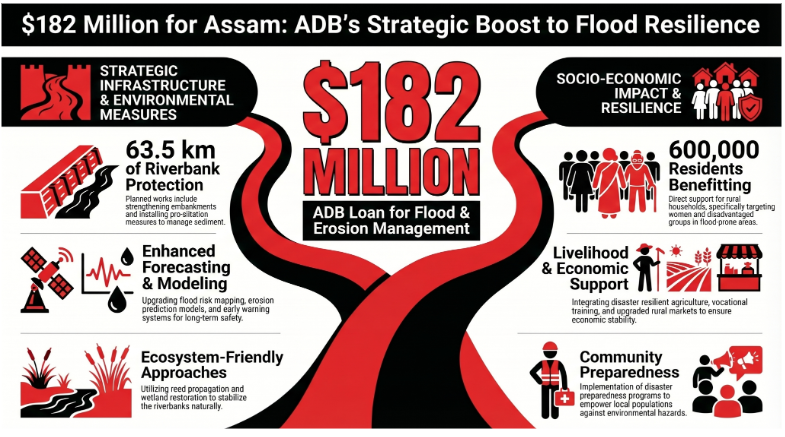
The Asian Development Bank (ADB) has approved a $182 million loan to the state of Assam, India, to address the chronic issues of flooding and riverbank erosion along the Brahmaputra River. This funding serves as additional financing for the ongoing "Climate Resilient Brahmaputra Integrated Flood and Riverbank Erosion Risk Management Project." The initiative aims to enhance the region's climate resilience through a combination of structural infrastructure, advanced technological forecasting, and ecosystem-based solutions. The project is projected to benefit approximately 600,000 rural residents, with a specific focus on disadvantaged groups, while simultaneously fostering economic resilience through livelihood support and vocational training.
Project Scope and Funding Objectives
The primary objective of the $182 million loan is to expand the existing management framework for the Brahmaputra River, targeting high-priority reaches that are particularly susceptible to environmental hazards.
Integration with Existing Initiatives: The funds bolster the Climate Resilient Brahmaputra Integrated Flood and Riverbank Erosion Risk Management Project, ensuring that previous efforts are scaled to cover more critical areas.
Targeted Demographics: The project specifically aims to protect and empower approximately 600,000 rural residents. This includes poor households, women, and other disadvantaged groups living in flood-prone zones.
Infrastructure and Technological Measures
The project outlines a multi-faceted approach to physical and digital infrastructure to mitigate the impact of the Brahmaputra’s volatile river dynamics.
Structural Interventions
Riverbank Protection: The plan includes the construction and maintenance of 63.5 km of riverbank protection.
Embankment Strengthening: Existing embankments will be reinforced to withstand severe water pressure and volume.
Pro-siltation Measures: The installation of measures designed to encourage sediment deposition will be utilized to naturally stabilize the riverbed and banks.
Technical Management and Forecasting
Forecasting Systems: Improvements to flood forecasting and early warning systems are prioritized to provide timely alerts to vulnerable communities.
Data-Driven Modeling: The financing supports the development of flood risk mapping and erosion prediction models.
Asset Management: The project includes comprehensive asset condition surveys to monitor the integrity of infrastructure over time.
River Calibration: Long-term hazard-resilient river calibration will be supported to better understand and manage river behavior.
Ecological and Environmental Integration
A significant component of the project involves "ecosystem-friendly" approaches, moving beyond traditional engineering to incorporate nature-based solutions.
Method | Objective |
Reed Propagation | To naturally stabilize soil and reduce the velocity of runoff/erosion. |
Wetland Restoration | To improve ecological stability and provide natural buffers for floodwaters. |
These measures are intended to reduce erosion and flooding while maintaining the ecological health of the Brahmaputra basin.
Socio-Economic Resilience and Livelihood Support
Recognizing that physical protection is only one aspect of disaster management, the project incorporates several initiatives to strengthen the economic floor of the affected populations.
Disaster-Resilient Agriculture: Promoting farming practices that can withstand or quickly recover from flooding events.
Vocational Training: Providing residents with skills that diversify their income sources beyond climate-vulnerable sectors.
Women-Focused Support: Tailored livelihood programs designed to improve the economic standing and resilience of women in the region.
Market Infrastructure: Upgrading rural markets to ensure that local trade can continue and thrive despite environmental challenges.
Community Preparedness: Implementing disaster preparedness programs to ensure residents are equipped to respond effectively to emergency situations.