
Introduction
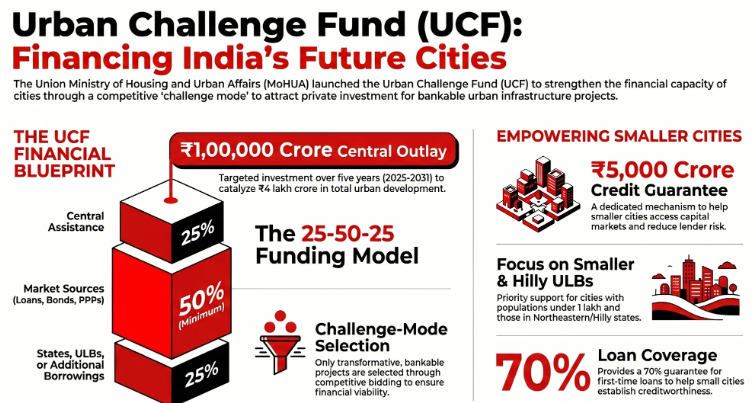
The Urban Challenge Fund (UCF) represents a strategic shift in India’s urban development paradigm, transitioning from traditional public-funded models to a market-linked, "challenge-mode" competitive framework. Launched by the Union Minister of Housing and Urban Affairs (MoHUA), the program is a Centrally Sponsored Scheme with a dedicated outlay of ₹1,00,000 crore for the period FY 2025–26 to 2030–31. Its primary objective is to catalyze nearly ₹4 lakh crore in urban investment over five years by "crowding in" private capital and mandating bankable project structures. Key features include an innovative 25:50:25 funding ratio and a ₹5,000 crore Credit Repayment Guarantee Mechanism specifically designed to support smaller cities and hilly regions. While the fund aims to transform cities into sustainable engines of growth for "Viksit Bharat," success depends on overcoming significant hurdles, including the limited creditworthiness of Urban Local Bodies (ULBs), technical gaps in project preparation, and the inherent risks of market-linked debt.
Program Framework and Financial Structure
The UCF is designed to move beyond the limitations of public finance, recognizing that state and central budgets alone cannot meet the massive infrastructure needs of modernizing cities.
Core Objectives
Competitive Selection: Projects are selected through a "challenge-mode," ensuring funding is directed toward transformative and financially viable (bankable) initiatives.
Vertical Alignment: The fund focuses on creative city redevelopment, strengthening cities as growth hubs, and improving water and sanitation infrastructure.
Investment Catalyzation: By leveraging the ₹1,00,000 crore central outlay, the program seeks to mobilize a total of ₹4 lakh crore in the urban sector.
Innovative Financing Model
The UCF mandates a diversified funding structure to ensure stakeholder accountability and market discipline:
Funding Source | Contribution Percentage | Details |
Central Assistance | 25% | Direct support from the Union Government. |
Market Sources | Minimum 50% | Raised through loans, municipal bonds, or Public-Private Partnerships (PPPs). |
States/ULBs/Market | 25% | Contribution from state/local budgets or additional market borrowings. |
Inclusivity and the Credit Repayment Guarantee Scheme
A major barrier to urban reform is the inability of smaller and geographically disadvantaged cities to access capital markets. To address this, the UCF includes a ₹5,000 crore Credit Repayment Guarantee Mechanism.
Scope and Eligibility
Target Cities: Cities with populations under 1 lakh and all cities located in Hilly and Northeastern states.
First-time Loans: Provides a 70% guarantee for loans up to ₹7 crore, enabling projects valued at approximately ₹20 crore.
Subsequent Loans: Provides a 50% guarantee for loans up to ₹7 crore, enabling projects valued at approximately ₹28 crore.
Purpose: To mitigate risk for lenders and provide smaller ULBs the necessary credit enhancement to raise funds for local infrastructure.
Strategic Focus on Private Sector Participation
The UCF is explicitly structured to transform cities into viable investment destinations. The program aims to foster private sector engagement through:
Market-Based Mandates: Requiring at least half of project funding to come from the market forces ULBs to adopt commercial discipline.
Project Support: The fund supports the preparation of Detailed Project Reports (DPRs), financial modeling, and advisory services to ensure projects are "PPP-friendly."
Risk Reduction: Credit guarantees and clear outcome-oriented guidelines help lower the perceived risk for private investors.
Critical Challenges and Implementation Risks
Despite its ambitious goals, the UCF faces several systemic and operational challenges that could impede its effectiveness:
Financial and Fiscal Constraints
Low Creditworthiness: Many ULBs suffer from weak revenue bases, poor financial management systems, and a lack of the "bankable" status required to attract private investors.
Debt Stress: Shifting to market-linked financing exposes ULBs to interest rate risks and repayment obligations. If projects fail to generate anticipated revenue, local bodies may face severe fiscal distress.
Technical and Institutional Barriers
Expertise Gaps: There is a significant lack of skilled manpower at the local level for complex tasks such as financial modeling, PPP structuring, and high-quality DPR preparation.
Institutional Inertia: Fragmented responsibilities and slow regulatory clearances may delay implementation.
Coordination Issues: The multi-stakeholder nature of the fund,involving the Centre, States, ULBs, and private financial institutions,requires high levels of inter-agency cooperation.
Regional and Scale Disparities
The "Big City" Bias: Larger cities with established administrative capacities are better positioned to win "challenge-mode" competitions, potentially leaving smaller towns behind and widening regional disparities.
Commercial Viability: Essential urban services like water and sanitation often have low commercial returns, making them less attractive to private players who prefer low-risk, high-return projects.
Eligibility Constraints: The exclusion of projects already funded under AMRUT 2.0 or SBM 2.0 may lead to fragmented urban planning and prevent the integration of ongoing initiatives.
Conclusion
The Urban Challenge Fund (UCF) marks a significant evolution in Indian governance, aligning urban infrastructure development with principles of financial sustainability and private sector efficiency. By incentivizing reforms and market participation, the fund seeks to create self-sustaining urban ecosystems. However, the transition from a grant-based to a debt-linked model necessitates a parallel focus on building the technical capacity and revenue-generating potential of Urban Local Bodies to ensure they can manage the fiscal responsibilities of a "Viksit Bharat."