
Introduction
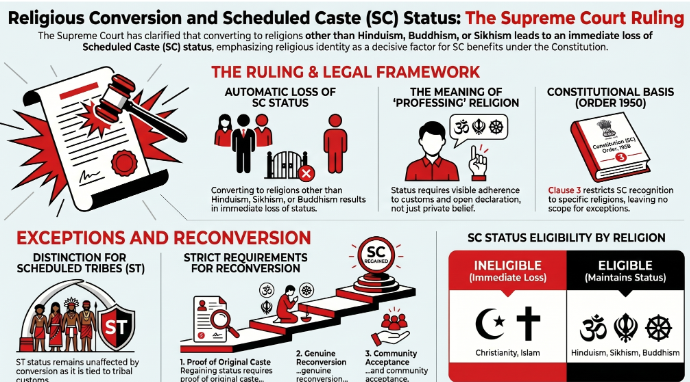
On March 25, 2026, the Supreme Court of India issued a definitive ruling regarding the intersection of religious identity and Scheduled Caste (SC) status. The court held that individuals who convert from Hinduism, Buddhism, or Sikhism to other religions, specifically citing Christianity in the underlying case, immediately and completely lose their Scheduled Caste status. This judgment reinforces Clause 3 of the Constitution (Scheduled Castes) Order, 1950, which limits SC recognition to specific religious groups. The court characterized this restriction as "categorical and absolute," emphasizing that caste-based benefits and legal protections, such as those under the Scheduled Castes and Scheduled Tribes (Prevention of Atrocities) Act, 1989, cease to apply upon conversion.
Judicial Determination and Legal Framework
The judgment, delivered by a Bench led by Justice Prashant Kumar Mishra, provides a rigorous interpretation of the constitutional provisions governing caste-based classification.
The Constitution (Scheduled Castes) Order, 1950
The ruling is anchored in Clause 3 of the 1950 Order. The court's analysis highlighted the following:
Religious Exclusivity: SC status is restricted to followers of Hinduism. This was later extended by law to include Sikhs and Buddhists.
Automatic Forfeiture: The loss of status is described as "immediate and complete" upon conversion to a religion outside these three faiths.
Irrelevance of Birth: The court clarified that birth into a Scheduled Caste does not preserve SC status if the individual chooses to convert to a non-recognized religion.
Defining Religious Profession
The court provided a detailed interpretation of what it means to "profess" a religion, establishing that it is not a matter of private conviction alone.
Public Manifestation: Professing a religion requires an open declaration and visible adherence to its customs and practices.
Theological Conflict: The judgment noted that Christianity, by its theological foundation, does not recognize the caste system. This theological absence reinforces the legal exclusion of Christian converts from SC classification.
Case Context: Eligibility for Legal Protection
The ruling arose from an appeal involving a man born into a Scheduled Caste who converted to Christianity and subsequently became a pastor.
The Dispute: The individual sought legal protection under the Scheduled Castes and Scheduled Tribes (Prevention of Atrocities) Act, 1989.
Judicial Finding: Both the High Court and the Supreme Court rejected the appeal, ruling that SC status cannot coexist with a professed religion that does not recognize caste.
Consequence: Because the individual was no longer recognized as a member of a Scheduled Caste post-conversion, he was ineligible for the specific protections afforded by the 1989 Act.
Distinctions and Provisions for Reversion
The Supreme Court distinguished the rigid religious requirements of Scheduled Caste status from those of Scheduled Tribes and outlined the path for those seeking to return to their original status.
Scheduled Caste vs. Scheduled Tribe Status
The court noted a significant difference in how these two classifications are handled:
Scheduled Castes: Status is strictly tied to religion as per the 1950 Order.
Scheduled Tribes: ST status is not strictly religion-based. Instead, it is determined by continued adherence to tribal identity, customs, and traditional practices.
Conditions for Regaining SC Status
The judgment outlined strict criteria for individuals who seek to regain their SC status through reconversion to Hinduism, Sikhism, or Buddhism:
Proof of Origin: Clear evidence of the individual's original caste must be provided.
Genuine Reconversion: The transition back to the recognized religion must be genuine.
Community Acceptance: The individual must be accepted back into the community of the original caste.
Summary of Key Legal Principles
Aspect | Rule/Requirement |
Primary Legal Basis | Clause 3 of the Constitution (Scheduled Castes) Order, 1950 |
Recognized Religions for SC | Hinduism, Sikhism, Buddhism |
Effect of Conversion | Immediate and absolute loss of SC status |
"Profess" Definition | Open declaration and practice (not just private belief) |
Protection Under 1989 Act | Limited only to recognized SC/ST members |
ST Status Basis | Tribal identity and customs (not strictly religion) |