
Introduction
The Small Hydro Power (SHP) Development Scheme represents a strategic government initiative designed to revitalize decentralized clean energy across India between fiscal years 2026-27 and 2030-31. With a total financial outlay of Rs. 2,584 crore, the scheme targets the installation of approximately 1,500 MW of power capacity. The program focuses specifically on small-scale projects (1 MW to 25 MW) in ecologically sensitive and strategically significant areas, such as the North Eastern states and international border districts. By leveraging 100% indigenous machinery and stimulating private investment, the scheme aims to achieve energy self-reliance while providing substantial socio-economic benefits to remote regions.
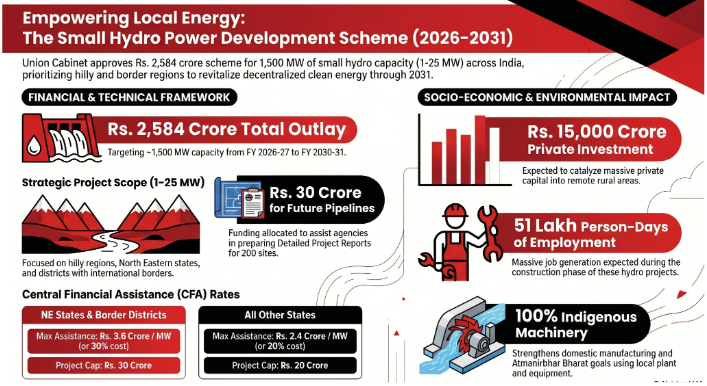
Scheme Overview and Objectives
The SHP Development Scheme is a specialized intervention aimed at harnessing water resources for power generation through localized, low-impact infrastructure.
Primary Goal: To add 1,500 MW of renewable energy capacity to the national grid.
Operational Window: The scheme is scheduled to run for five fiscal years, from 2026-27 to 2030-31.
Project Classification: Eligibility is restricted to hydro projects with a capacity range of 1 MW to 25 MW.
Geographic Priority: Specific emphasis is placed on hilly regions, the North Eastern (NE) states, and districts situated along international borders.
Financial Framework and Central Financial Assistance (CFA)
The scheme provides tiered financial support based on the location and strategic importance of the project. The Central Financial Assistance is structured as follows:
Region Category | Financial Support (CFA) | Maximum Cap per Project |
NE States and Border Districts | Rs. 3.6 crore per MW or 30% of project cost (whichever is lower) | Rs. 30 crore |
Other States | Rs. 2.4 crore per MW or 20% of project cost (whichever is lower) | Rs. 20 crore |
Socio-Economic and Strategic Impact
The implementation of the SHP Development Scheme is expected to trigger significant economic activity and strengthen domestic industry.
Economic Catalyzation
Private Investment: The government outlay of Rs. 2,584 crore is projected to catalyze approximately Rs. 15,000 crore in private sector investment.
Employment Generation: The construction phase alone is expected to generate 51 lakh person-days of employment.
Long-term Sustainability: Projects are designed for a lifespan of 40 to 60 years, ensuring stable, long-term employment and local investment in remote areas.
Industrial and Strategic Alignment
Atmanirbhar Bharat: The initiative mandates the use of 100% indigenous plant and machinery, thereby strengthening the domestic manufacturing base for renewable energy technology.
National Security: By focusing on border districts, the scheme supports infrastructure development in strategically sensitive zones.
Technical and Environmental Advantages
Small Hydro Power projects offer distinct advantages over large-scale hydroelectric dams, particularly regarding environmental impact and grid efficiency.
Environmental Sustainability: SHP projects are characterized by a smaller footprint, which minimizes:
Large-scale land acquisition.
Deforestation.
Displacement of local populations.
Grid Efficiency: As decentralized energy sources, these projects are located closer to the point of consumption. This proximity reduces transmission losses and diminishes the necessity for extensive and costly long-distance transmission infrastructure.
Future Pipeline Development
To ensure a continuous trajectory of growth beyond the immediate scheme targets, the government has allocated Rs. 30 crore specifically for project preparation. This funding is dedicated to assisting agencies in the creation of Detailed Project Reports (DPRs) for approximately 200 future projects, ensuring a robust pipeline for the small hydro sector in the coming years.