
Introduction
As of the week ending February 27, 2026, India’s foreign exchange (forex) reserves reached a historic peak of $728.49 billion. This milestone, reported by the Reserve Bank of India (RBI), reflects a weekly increase of $4.885 billion. The primary catalyst for this growth was a substantial appreciation in gold holdings, which surged by over $4 billion. These record-breaking reserves signify a robust external financial buffer, enhancing India's macroeconomic stability and its capacity to withstand global financial volatility while maintaining the stability of the rupee.
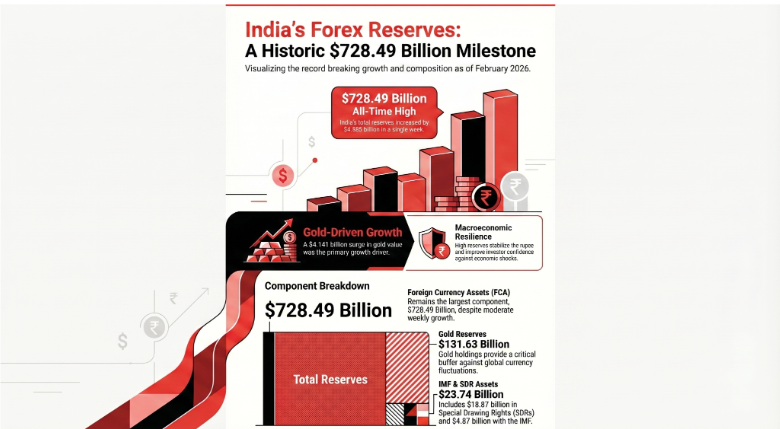
Overview of Forex Reserve Components
India's foreign exchange reserves are comprised of four distinct categories managed by the RBI. The following table details the status of these components as of the reporting week ended February 27, 2026:
Reserve Component | Current Value (USD) | Weekly Change (USD) |
Foreign Currency Assets (FCA) | $573.125 Billion | + $561 Million |
Gold Reserves | $131.63 Billion | + $4.141 Billion |
Special Drawing Rights (SDRs) | $18.87 Billion | + $26 Million |
Reserve Position in the IMF | $4.87 Billion | + $158 Million |
Total Forex Reserves | $728.49 Billion | + $4.885 Billion |
Primary Drivers of Growth
The Role of Gold Holdings
The most significant contributor to the recent surge in reserves was the increase in gold holdings, which rose by $4.141 billion. This sharp rise underscores the strategic importance of bullion in diversifying India’s reserve portfolio. Gold serves as a critical hedge against:
Global financial volatility.
Fluctuations in international currency values.
Foreign Currency Assets (FCA)
Foreign Currency Assets remain the largest single component of the total reserves, valued at $573.125 billion. These assets consist of holdings in major global currencies, including:
The Euro
The Pound Sterling
The Japanese Yen
The value of the FCA is subject to fluctuation based on the movement of these currencies against the US dollar. During the reported week, these assets saw a moderate increase of $561 million.
Strategic Importance and Economic Implications
The attainment of record-level forex reserves is a key indicator of India’s resilience within the global financial system. The primary benefits of maintaining these high reserves include:
Currency Stabilization: High reserves provide the RBI with the necessary capacity to intervene in currency markets to stabilize the rupee during periods of volatility.
External Shock Mitigation: The reserves act as a buffer against external economic shocks, protecting the domestic economy from global instability.
Investor Confidence: Strong reserve levels improve international investor confidence in India’s economic management.
Import Financing: Large reserves ensure the country's continued ability to finance essential imports regardless of global market conditions.
Technical Definitions and Management
The management and reporting of these assets are handled by the Reserve Bank of India (RBI). Key technical elements include:
Special Drawing Rights (SDRs): These are international reserve assets created by the International Monetary Fund (IMF) to supplement the official reserves of member countries.
IMF Reserve Position: This represents the portion of the quota of a member country’s reserves held with the IMF that can be accessed without conditions.
Valuation Dynamics: Total reserve figures are influenced not only by physical acquisitions but also by the valuation changes of non-dollar assets and gold in the international market.